The Little Mermaid

My review of a piece of sculpture I admire, with reflections on the language used:
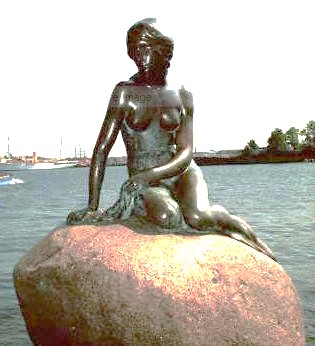
One classical sculpture that I admire, for its beauty and romantic history, is the ‘Den Lille Havrue’. 

Originating from an 1837 fairy tale about a 15 year old girl, commissioned by a beer baron to bear the adult face of his obsession (and beautifully sculptured in bronze in 1912), the statue was finally unveiled in 1913. 

Sitting atop a rock, naked and alone, the young woman looks across to the ruinous land, thinking about the waters below, where she spent her childhood years, in a world underneath the sea.

The background harbour forms an oppressive barrier, adding more gloom to the tale, where she traded her singing voice (by removal of her tongue), for a pair of human legs – so that she could marry the prince, whom she had earlier saved from a shipwreck.

It is a sad story, because she would never marry the prince. 

She was destined to never be able to live under the sea again, and when she walked on the land, each step produced unbearable pain.

Most folklore portrays mermaids as haters of all men, luring sailors to jump into the sea, to drown.  Hans Christian Anderson changed the tables, portraying the mermaid as a heroine, and the generally accepted handsome prince as a ‘rattus rattus marinus’. 

Every year, millions of people visit ‘The Little Mermaid” (English translation) in Copenhagen, Denmark, for she is now a symbol of national strength in the face of adversity, and an inspiration for children with pure imagination.

The sculptor, Edvard Erichsen reproduced the face of Ellen Price, a solo dancer in the ballet ‘The Little Mermaid’, faithfully into the sculpture, as brewer Carl Jacobsen (Carlsberg Brewery) had commissioned the work.  The nude modelling had to be passed on to Erichsen’s wife, as Price was reluctant to show more than her face to the sculptor.

The statue weighs 175kg, and although surviving wars and the Great Depression, modern vandals have not been so kind to her.  One severed arm, two decapitations and several attempts to paint her red and fitting her with a bras, have taken their toll.  Visitors have climbed on top of her, wearing away some of the bronze, leaving her a dark and faded brown – unless highlighted by camera flashlight.  She will soon be imprisoned behind a security fence, adding another atrocity to the memorial of a famous heroine.

Erichsen froze the statue into a metamorphosis, providing both legs and fish tail – contrary to the Andersen story of having either one or the other.  The purpose was to define the meaning of the statue.  The best time to approach the statue, is when the weather is grey and overcast – bringing out more feelings of isolation.

She sits side-saddle on the rock, her small 1.6 metre frame disappointing many.  The statue is easily accessible from the front and sides, allowing an appreciation of the sculptor’s portrayal of the living form, especially seen through the arched back.  The flowing tail hugs the downward slope of the ovoid rock. 

Her stooped pose conveys the feeling of despair. And yet, with her weight resting on one arm, and her other hand reaching across her thigh, there seems to be hope, that her waiting may bring sight of her lover. Walking around the statue on the shore, the history and meaning of her plight seems real. 

There is a feeling of loss that only increases when imagining the statue being unveiled in 1913 – in full splendour, shining with fine feature, and revealing her wonderful face.

(c) Stefan Nicholson 2009

Reflection on language used:  By necessity the language is emotional, historical and descriptive.  The art and its history are eternally bound together through folklore and expectations of the audience (readers of the book, and lovers of sculpture). 

The subject needs a longer review because of its complexity – yet for such a simple study, of a girl sitting on a rock.

Writing History

The Writing of History and Biographies

I am a great fan of Lewis Carroll – the mathematician who became a writer of children’s books and nonsense poetry.  He observed the world around him, and applied logic to show that what we see, and our understanding of it, depends on your perspective.  So too, with the writing of history: people, places and times.

Wearing his hat for a few minutes, I would have to conclude, that everything that is not most useful, is necessarily less useful) – an interesting question for this week.  And yet, if anything is useful, it is just that – otherwise it would be useless. Say that fast, three times.

From historical evidence and sequence of events, a biographer presents the logic of the true event, and the story teller within, moulds this into the storyline – or it can work the other way around. Biography is the true story – as can be reasonably told based on fact and reasoning, notwithstanding that some biographers lie through their teeth.

So, how do you write about history?

  • I have learnt that writing history demands the mastery of being able to tell a story, while simultaneously telling the truth in critical areas.  False account and erroneous fact will be picked up by the critic.  Reputation is closely linked to accuracy and meeting audience expectations. The facts of history may be consciously or unconsciously distorted by bias and/or malice – depending on the context of the events by the writer.
  • Historical fiction is the incorporation of real historical events and figures, into a story line, whereby the setting must be true to the reality of the past.  Sometimes the characters are themselves, and at other times, generally when sensitivities and legalities are required, the characters may have new names – or nick-names.
  • A hard-nosed journalist will write the historical work according to the facts.  The writer of a biography or autobiography will write a memoir or complete life-story, adding their own bias of thoughts and feelings.  An historical fiction writer will use imagination and lateral thinking to work in with history, and build up an entertaining, action-packed story, using story board technique and character role play.
  • I have learnt how to gather information from linked sources, as well as family and friends of family.  We have each recounted the affect that events may have on the history of the family – notable migration, marriages, deaths and wars.
  • Hidden stories, secret facts, and sensitivities within the family history, must be explored, debated and effectively dealt with to ensure a “reasonable” and ethical outcome for all parties.  The possibility of sitting on a story, to synchronise the release of truth, while avoiding litigation and copyright issues, has been well rewarded many times.  A good lawyer should always provide the ultimate advice on such matters.
  • Visuals, choosing fiction writing and acknowledging the requirement to tell a story at its best, taught me that the story-line and audience participation is of prime importance.  The audience becomes the writerly-reader – adding another dimension to the existing work. Visuals may be used to reduce some of the descriptive embellishment – allowing photos and graphics to “show” by example.  This enhances the concise narrative and dialogue, to create a mood or historical atmosphere, so that the reader’s imagination is encouraged – rather than being lectured to.
  • Finally, I have learnt through the experiences of fellow students, lecturers, authors and supporting readings, that there is both pleasure and pressure experienced by the historical writer.  Whether you choose to write imaginative historical fiction, or engage in rigorous and academically precise researching for biography, or classical historical works, there are expectations of sensibility and much research of material.

Where to go from here with the writing of your next book?

“That depends a good deal on where you want to get to,” said the Cat

“I don’t much care where ——“, said Alice.

“Then it doesn’t matter which way you go,” said the Cat

“—- so long as I get somewhere,” Alice added as an explanation.

“Oh, you’re sure to do that,” said the Cat, “if you only walk long enough” 

(excerpt from Lewis Carroll’s “Alice in Wonderland”)

I am going to have a long thoughtful walk, and plan out another interesting historical work. I lived the life of Adam Lindsay Gordon for long enough to share his experiences, when I wrote a poem for the Adam Lindsay Gordon Association – and came out of it a wiser man – and second prize winner.

Best regards to everyone.  I hope to be reading your published works in the near future.