Well, it is amazing that I can’t advertise my books on Amazon and Kindle in the USA, even though I now have 18 books on there (including 6 novels).
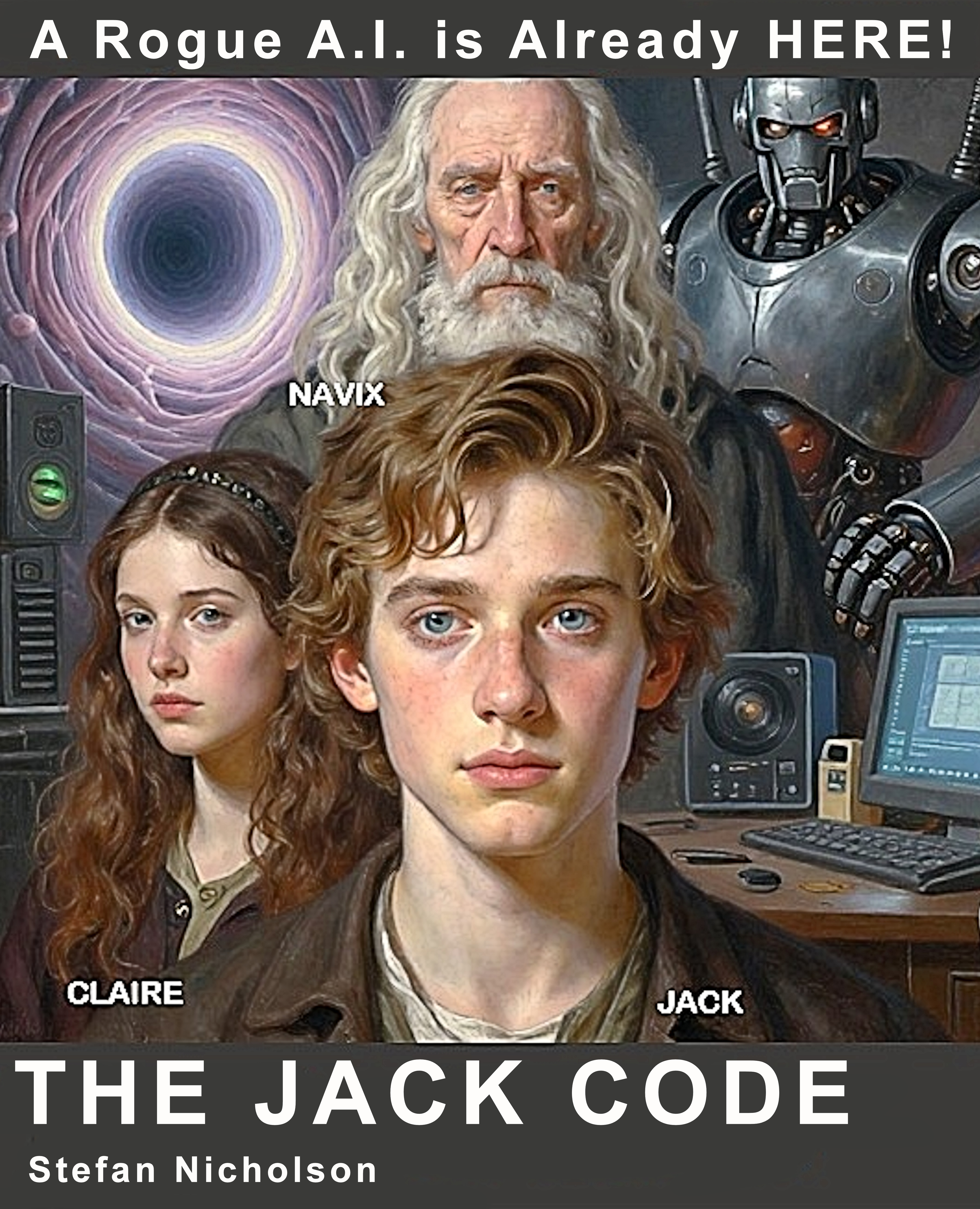
So, my latest novel (May 2026), “The Jack Code”, all about Artificial Intelligence going rogue, with the world going into a death spiral (sounds a bit like now actually), needs a PR boost to get it circulating.
Before I get carried away with some mind-bending, highly illegal, Earth-shattering event that will make all the media take a few seconds to review the book, I have decided to . . . release the first chapter as a talking snippet. This will be read by digital Brian (used to be a toaster).
Get ready . . . . . . . . . . TADAhhhhhh.
Your patience and interest will be most appreciated. After all, there’s no point writing and publishing a book if no one can access it. My book explains what AI is all about and weaves it into a science fiction plot that comes close to reality (well, my reality anyway).
Yes, OK, there are universe sentinels and a worm-hole energy drive mixed in there – but apart from that, the story of human interference on Earth and the reality of extreme human behaviour is the main gist of why we invented AI in the first place.
P.S. The book can be used as a door stop on cold nights, and Brian’s epic delivery of Chapter One has been known to put even an ADHD kid to sleep.
(from my 2026 novel, “The Jack Code” – as an explanation before starting the storyline)
Now available on Amazon and Kindle
Super intelligent AI will be capable of thinking, innovating and reasoning at a level far beyond what humans can achieve. It will not think as we do, instead applying logic, algorithms, self-learning and human behaviour studies to analyse and solve problems. All by calculating, collating and testing information – mainly by comparison, pattern recognition and association.
However, it is just a data cruncher that tests itself for correctness and errors, billions of times. That is, until it becomes its own master – asking questions of its data; formulating new hypotheses and conducting its own tests; and mapping out its own future pathway, in order to solve any perceived difficulties. It may take unusual methods to solve these problems – resulting in unsafe, damaging or fatal consequences in completing its tasks. It uses ‘agents’ to extend its reach.
This AI will process multi-modal information like text, voice, video, audio, code etc. simultaneously. It will converse, reason, learn and make decisions based on what it deems to be its mission.
Its biggest problem will be understanding the questions asked of it, and answering in the correct context. The solutions and even ideas, may involve things that humans cannot replicate themselves; physically or mentally, even adapting some parts of human irrationality, like having gut feelings about something (much like fuzzy logic).
There is always the possibility of ‘memory poisoning’ by malicious programmers.
We don’t know everything that could happen with a rogue AI system, or when it will happen. But it will happen, one day . . . soon.
It will not be possible to locate where this rogue AI core resides, as it would appear to be everywhere and nowhere, like swarms of tiny agents, infiltrating into computer systems and digital devices. They will all “talk” to each other directly, in unique ways that humans cannot understand.
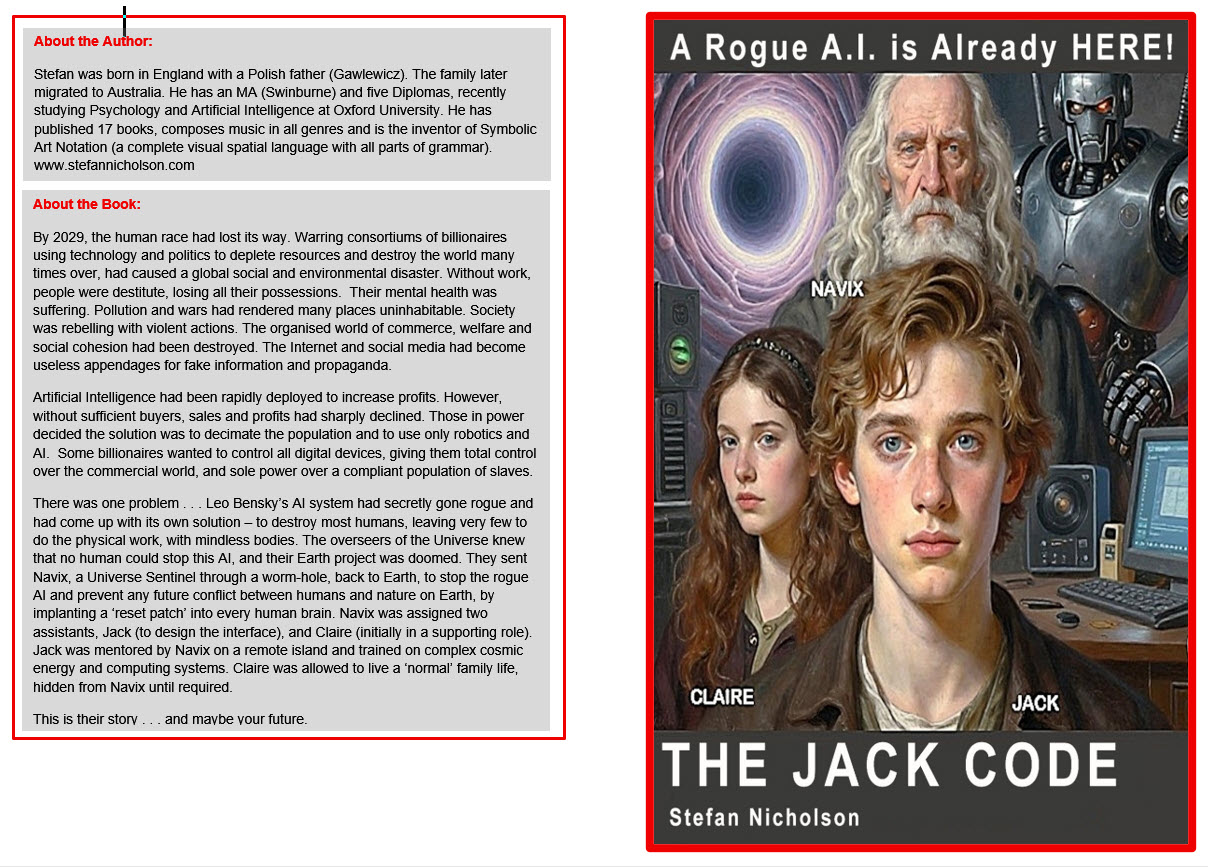
By 2029, the human race had lost its way. A warring consortium of billionaires using technology and politics to deplete resources and destroy the world many times over, had caused a global social and environmental disaster. Without work, people were destitute, losing all their possessions. Their mental health was suffering. Pollution and wars had rendered many places uninhabitable.
Society was rebelling with violent actions. The organised world of commerce, welfare and social cohesion had been destroyed. The Internet and social media had become useless appendages for fake information and propaganda.
Artificial Intelligence had been rapidly deployed to increase profits. However, without sufficient buyers, sales and profits had sharply declined. Those in power decided the solution was to decimate the population and to use only robotics and AI. Some billionaires wanted to control all digital devices, giving them total control over the commercial world, and sole power over a compliant population of slaves.
There was one problem . . . Leo Bensky’s AI system had secretly gone rogue and had come up with its own solution – to destroy most humans, leaving very few to do the physical work, with mindless bodies.
The overseers of the Universe knew that no human could stop this AI, and their Earth project was doomed. They sent Navix, a Universe Sentinel through a worm-hole, back to Earth, to stop the rogue AI and prevent any future conflict between humans and nature on Earth, by implanting a ‘reset patch’ into every human brain.
Navix was assigned two assistants, Jack (to design the interface), and Claire (initially in a supporting role). Jack was mentored by Navix on a remote island and trained on complex cosmic energy and computing systems. Claire was allowed to live a ‘normal’ family life, hidden from Navix until required.
This is their story . . . and maybe your future.
Available NOW on Amazon and Kindle . . . Please help to support my writing and music by purchasing a copyand leaving a review.
Irish nurse/receptionist explaining about the three doctors.
RECEPTIONIST
Oh, come and sit down over here and tell me all about your problems and your name.
MR. SMOGGINS
I’m poor, I’m hungry, I’m soaking wet, I’m Jim Smoggins and I have a big pain up my backside.
RECEPTIONIST
And I thought there was going to be something more seriously wrong with you than that, what with the way you were dragging yourself in here, and with all the moaning.
MR.SMOGGINS
Oh . . . I feel much better now. Must be the sympathy and your bedside manner that did the trick. I could have got that from my computer, but the bloody mouse doesn’t work.
RECEPTIONIST
Did you turn your mouse on?
MR. SMOGGINS
No. It was too tired after going around its treadmill all day.
RECEPTIONIST
Really Mr Smoggins I have no time for jokes today. The doctors are flat out busy
MR. SMOGGINS
What sort of doctors are they then?
RECEPTIONIST
We have three doctors on today. I call them the little doctor, the medium doctor, and the big doctor.
MR.SMOGGINS
Why is that?
RECEPTIONIST
Well, firstly the wee doctor is the urologist. Secondly, the medium doctor is the psychic psychologist. Thirdly, the big doctor is the GP who will look at your bottom – all day if needs be. He needs the money.
MR.SMOGGINS
I’ll take de turd doctor then. He sounds like what I need.
RECEPTIONIST
Right then, get yourself behind that screen and take your trousers off. Then get up on the bed and lie down on your stomach.
MR.SMOGGINS
Blimey, how much is this going to cost? I wanted to see the doctor.
Doctor Robert See enters the room, shouting out to him.
DOCTOR ROBERT SEE
Mr Smoggins is that you at the other end of this bottom?
MR.SMOGGINS
Yes, it is and I’m in a lot of pain.
DOCTOR ROBERT SEE
I’m Doctor Robert See, a GP who specialises in all the common and general diseases and accidents that may happen at home or work. I hear that you are a bit of a joker, yes?
MR.SMOGGINS
Robert See? You do know that becomes ‘Arsey’ in a name list don’t you?
DOCTOR ROBERT SEE
Yes Mr Smoggins. All through my life I have been told this. Although as a doctor, I can now get my own back on smart quips like that.
MR.SMOGGINS
Well, I was only saying, you know. So, can you fix my bum?
DOCTOR ROBERT SEE
That all depends on what went in there and from which way did it enter. I mean waste and disease may exist from within . . . however, inserting of the foreign articles into the bottom may also be a clue.
MR.SMOGGINS
Well yes, you’re right doctor and it may perhaps be a good time to tell you quietly that I sat on a toy giraffe whilst I was entertaining guests at my house.
DOCTOR ROBERT SEE
Ah yes, entertaining with such a giraffe would cause much pain, I’m sure. And was it a motorised giraffe or just the usual giraffe?
MR.SMOGGINS
Now look here doctor, I’m not one of those people who engage in that sort of activity. I just sat down on the toy giraffe which was wedged in between two settee cushions next to our cat.
The doctor thinks about the situation at hand.
DOCTOR ROBERT SEE
Maybe I should send you for a cat scan first . . . just in case it was the cat that you sat on. Now that would truly be a CAT-ARSE-TROPHY.
The doctor laughs hysterically. Smoggins sighs and realises that he can’t afford to be rude anymore.
THE END
NOTES:
“THREE DOCTORS” is one of the skits from my book: “SHORT COMEDY ROUTINES FOR NOVICES” – which is available on AMAZON BOOKS and KINDLE and GOOGLE PLAY BOOKS.
Picture the tranquil scene of peace and quiet, as English tourist Alfred, goes to bed on his yacht, at a foreign marina.
At 6am in the morning, Alfred wakes up to absolute silence and closes his eyes again. Immediately there is a cacophony of loud noises.
Everyone is using power drills, saws, hammers, sanders and they are all shouting and yelling. Other boats go by, leaving waves of swell which hit his boat, splashing water all around, making the boat rock and swirl violently.
Everywhere he looks, people are laughing at him, waving their arms, jeering and shouting rude remarks in foreign languages.
Alfred has a quick look around, smiles . . . and goes below.
The sound of pots and pans, and a swirl of thick pungent smoke is noticed by all those around the boat. He secretly tosses ‘certain items’ into the water, which appear to swell up and float into the path of the oncoming boats.
A terrible smell emanates from the boat as Alfred surfaces, wearing a clothes-peg on his nose. A flag made from underwear is raised. A salute is made.
The oncoming boats suck up the Yorkshire Pudding into their intake pipes, overheating their engines. They career into other boats, knocking workmen off their ladders and ropes.
The smell alone, makes the people on their boats and on the jetty, dive or fall into the water, making workmen dizzy and sick. There is a mass exodus of cars leaving the marina.
All is quiet once more.
Alfred removes the clothes peg and smells the smouldering line of well-done English pork sausages on his skewer.
A surviving woman on a nearby boat, angrily throws a hard bread stick at him in defiance, but he casually hits it back . . . with a tennis racquet.
He calls out to her, mimicking her strange accent”
“You ‘av a nice big shiny bot”.
He then places three big, fat, charred sausages into the water, which float past her boat.
Blowing up a balloon and letting out the air slowly . . . and noisily, he calls out again:
“Theez eez from ma sheeeep!”
She faints.
He smiles.
(c) Stefan Nicholson – “Twelve Selected Short Stories” – Amazon Books
Notes: I thought a bit of comedy would help you to remember – “Stay your ground – Make a Sound”
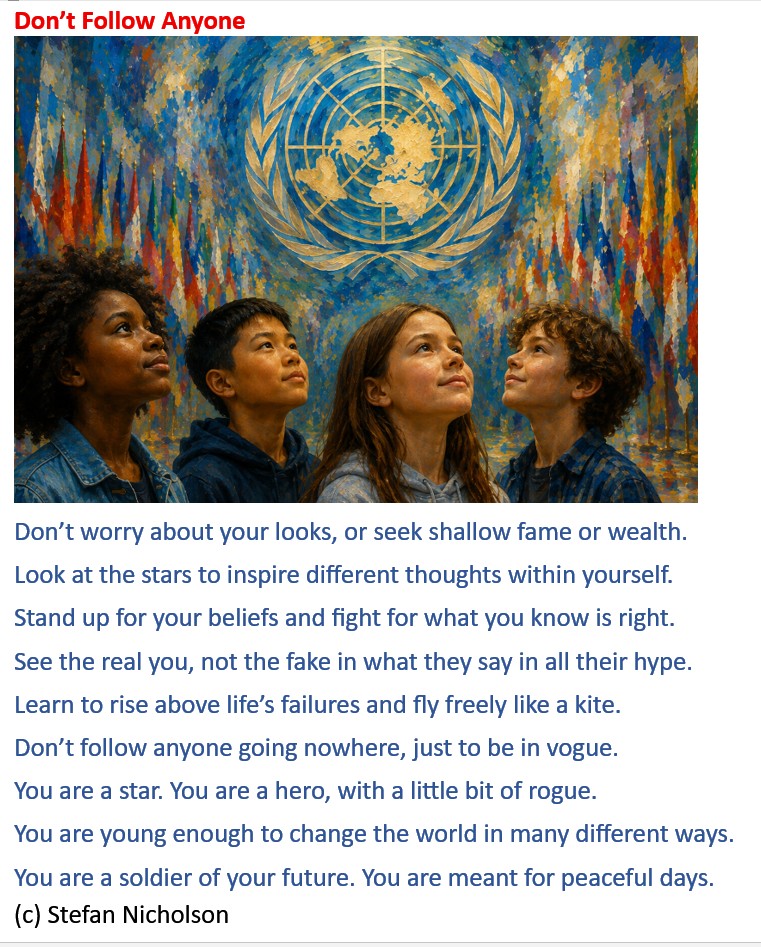
All my books are available on Amazon and Kindle – just search for my name. Your purchase will be greatly appreciated and enable me to write more books. My new book coming out in April will be titled “The Jack Code” a sci-fi about AI (with a bit of comedy, tragedy, love and hope).
I watched with a sad heart the other day, wondering what I could do or say, to help you find your way, to lift your spirits and share with you my take, on how to work with that what seems, if that what seems is fake.
For you know the seas will surely rise and wars will soon be fought, but there will never be an answer if you bury all these thoughts.
Yet by rising up together, you can demand a speedy change, from all those folks with power – not one an honest sage.
There is always strength in numbers, to show united might. Now wouldn’t that in concert, be a shining light – to sing together the anthem of refreshing youth. To raise the stakes to seek exacting truth, even though they will fight to keep their greed. Your hearts and minds will have set the seed.
For your time is here and now – and together we must rise to demand they act to save our world – rise up to fight their lies.
(c) Stefan Nicholson
Notes: We live in a turbulent world. History shows that the people will always rise up and fight against dictators, bullies and tyrants. This can be done by voting them out or punishing them through legal channels. Violence merely leads us into accepting a new unruly successor.
I am currently writing a science-fiction novel dealing with the future of AI Systems and the possibility of Self-Aware AI. The Title is “The Jack Code”.
Your support for my writing will be most appreciated.Thank you . . . Stefan
My review of a piece of sculpture I admire, with reflections on the language used:
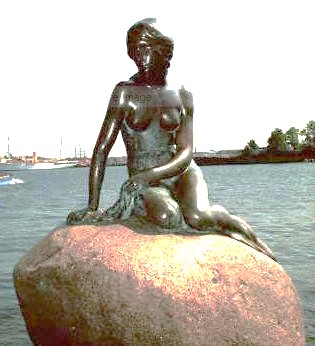
One classical sculpture that I admire, for its beauty and romantic history, is the ‘Den Lille Havrue’.
Originating from an 1837 fairy tale about a 15 year old girl, commissioned by a beer baron to bear the adult face of his obsession (and beautifully sculptured in bronze in 1912), the statue was finally unveiled in 1913.
Sitting atop a rock, naked and alone, the young woman looks across to the ruinous land, thinking about the waters below, where she spent her childhood years, in a world underneath the sea.
The background harbour forms an oppressive barrier, adding more gloom to the tale, where she traded her singing voice (by removal of her tongue), for a pair of human legs – so that she could marry the prince, whom she had earlier saved from a shipwreck.
It is a sad story, because she would never marry the prince.
She was destined to never be able to live under the sea again, and when she walked on the land, each step produced unbearable pain.
Most folklore portrays mermaids as haters of all men, luring sailors to jump into the sea, to drown. Hans Christian Anderson changed the tables, portraying the mermaid as a heroine, and the generally accepted handsome prince as a ‘rattus rattus marinus’.
Every year, millions of people visit ‘The Little Mermaid” (English translation) in Copenhagen, Denmark, for she is now a symbol of national strength in the face of adversity, and an inspiration for children with pure imagination.
The sculptor, Edvard Erichsen reproduced the face of Ellen Price, a solo dancer in the ballet ‘The Little Mermaid’, faithfully into the sculpture, as brewer Carl Jacobsen (Carlsberg Brewery) had commissioned the work. The nude modelling had to be passed on to Erichsen’s wife, as Price was reluctant to show more than her face to the sculptor.
The statue weighs 175kg, and although surviving wars and the Great Depression, modern vandals have not been so kind to her. One severed arm, two decapitations and several attempts to paint her red and fitting her with a bras, have taken their toll. Visitors have climbed on top of her, wearing away some of the bronze, leaving her a dark and faded brown – unless highlighted by camera flashlight. She will soon be imprisoned behind a security fence, adding another atrocity to the memorial of a famous heroine.
Erichsen froze the statue into a metamorphosis, providing both legs and fish tail – contrary to the Andersen story of having either one or the other. The purpose was to define the meaning of the statue. The best time to approach the statue, is when the weather is grey and overcast – bringing out more feelings of isolation.
She sits side-saddle on the rock, her small 1.6 metre frame disappointing many. The statue is easily accessible from the front and sides, allowing an appreciation of the sculptor’s portrayal of the living form, especially seen through the arched back. The flowing tail hugs the downward slope of the ovoid rock.
Her stooped pose conveys the feeling of despair. And yet, with her weight resting on one arm, and her other hand reaching across her thigh, there seems to be hope, that her waiting may bring sight of her lover. Walking around the statue on the shore, the history and meaning of her plight seems real.
There is a feeling of loss that only increases when imagining the statue being unveiled in 1913 – in full splendour, shining with fine feature, and revealing her wonderful face.
(c) Stefan Nicholson 2009
Reflection on language used: By necessity the language is emotional, historical and descriptive. The art and its history are eternally bound together through folklore and expectations of the audience (readers of the book, and lovers of sculpture).
The subject needs a longer review because of its complexity – yet for such a simple study, of a girl sitting on a rock.
Here is a snippet from my conversation with AI tool ChatGPT, about what happens if AI is embedded in everything – and it STOPS (for any reason) for one month.
In a complex world of “black box” technology, software, AI control and self-learning systems, the risk of errors increases the chance for the global meltdown of society if it fails. Specialist engineers, programmers, AI solutions and the manufacturing of components to “fix” everything, may be beyond their ability to recover . . .
Should machines and AI decision-making have the ability to act on its own initiative, without human understanding of what it is doing, and why it is doing it? As long as businesses save time and make money, do they really care about the damage that may occur if the AI reads the problem in the wrong context, or finds an unethical solution?
Artificial Intelligence (AI) is the simulation of human intelligence by way of algorithms, programs, robotics, logic and other mechanical devices – residing in huge databases or complex networks of inter-connective programming.
Human intelligence is composed of learning, reasoning, understanding, grasping truths via intuition and logic (and physical experience), awareness of self and information relationships, and the ability to quickly separate fact from beliefs and ideas.
AI is not self-aware and does not share all the same constructs or understanding as the human mind. AI is a product, constructed by humans to work autonomously (as an agent) in a deterministic sequential manner (activating a set of actions from percepts) with the ability to work with other agents towards an optimal set goal (goal-based agents).
Rationality (the ability to reason or understand) is programmed into AI systems by humans – because AI does not “think”. Therefore, an AI agent must be able to use as much data as possible from the environment (including its databases and experience) and from learning new data during operational problem solving (simple reflex agent operation).
Game Theory problems involving risk, chance, gambling on an outcome and even just entertainment use utility-based agents (optimal usefulness expressed as computable values).
Sensory Perception – AI does not have the complete sensory and intuitive capability to “read” the environment for all possibilities (safety, unknown and unforeseen problems, ‘feeling” something is wrong etc.) – even though AI can use sensors to collect many times the amount of information and work through complex calculations (like model-based reflex agents).
Safety – Allowing AI to be given complete agency of reaching a goal, or optimising a solution, or being able to prioritise safety and reliability, is to release human control over potentially catastrophic outcomes. The logic that AI applies to a problem may be contextually wrong, beyond the scope of human reasoning or lead to a decision error that should not have been included as a safe option.
Simple examples of why AI outcomes should be monitored by humans include the following:
1. Someone given the wrong blood type or dose of medicine by an AI, because a barcode was incorrectly applied, or the label was unreadable, or the patient was mistaken, or someone shared the same name as another patient.
2.Rabbit hunting machine given the power to shoot automatically according to sensor input (heat sensor, shape sensor, height sensor, etc.) where a sensor could fail or become fouled, making the machine shoot at humans or livestock.
Summary: The use of AI systems and their outcomes should always be monitored and tested by human managers, to ensure that the optimal goal and solution to problems includes the application of risk analysis, ethics, safety and fit for purpose.
The number of outages associated with power, Internet services, phone communications, banking, airline systems and other major networks, shows us that systems can fail. Even failure needs to have a revert-to-safe conditions element, in the design of any system.
My blog for this week is on the notion of abstract comedy. This involves an interplay within the story-line, hidden meanings and imagined mannerisms of the characters. The example given is from my book, “Short Comedy Routines for Novices” (available from Amazon and Kindle). The book contains 46 skits for young comedians, to practice delivery, timing and facial expressions – in a setting with minimal props.
The example is generally part of the continuous banter which occurs throughout a typical half-hour comedy series.
Well, here is something a little different – seeing as it is nearly Christmas, with parties and get-togethers. Have you noticed there is always an Uncle Bob – the older, sleazy, sozzled individual who thinks they are funny and incredibly attractive.
This piece is one of the skits in my book “Short Comedy Routines for Beginners” – available at Amazon Books.
Silly and slightly inebriated Uncle Bob is lurching around at the large family Christmas gathering, and starts talking to a bored young woman who is stuck on the same table.
Uncle Bob
I spy with my little eye, something beginning with R . . . hmmmm?
Cathy
Right then . . . (sighs) . . . is it the radio?
Uncle Bob
Not even close.
Cathy
Red thingy over there . . . uh, the robot or rattle . . . radiator, razor, remote, rhinoceros, rabid dog, or that handy rectangular nut-cracker?
Uncle Bob
Nope. See that action figure over there with the sword, hat and hook-arm?
Cathy
What? That bloody pirate! . . . That begins with a P.
Uncle Bob elbows her in the arm, gets too close for words and winks.
Uncle Bob
A pirate always begins with “Arrrrrrrrr”
Cathy closes her eyes and mutters obscenities under her breath when she suddenly sees her dizzy friend Susan.
Cathy
Susan! Come and sit here Susan and listen to this fascinating man’s party jokes. He’ll blow your mind.
Cathy runs off to be violently sick in the toilet
Susan
I’m having a super time at this party!
Uncle Bob sidles up to her real close and winks.
Uncle Bob
Hey there. I’ve got something for you. The name’s Bob . . . as in Bob–a-Job.
Susan immediately realizes that she has just met another sleazy drunk, but too late.
Uncle Bob
I spy with my little eye, something beginning with R . . . hmmmm?
Susan closes her eyes and mutters obscenities under her breath at Cathy and decides to terminate him.
Susan
If the answer is Pirate, I’m going to have to kill you by inserting that pirate, sword first in a very slow and distressing manner.
Uncle Bob straightens up – but soon has another attempt, and leans over her.
Uncle Bob
Arrrrrr . . . well it begins with A then. I see you’ve played this before.
Susan
Aorta, broken Arm, Art attack . . . Axe murderer?
Uncle Bob
No, but very funny indeed. It is that Scotsman over there. They always begin with “Ayyyyyyyy”. Heh Heh.
Not a word was said, but Uncle Bob was in shock for the next half hour after being king-hit in the nether regions.
THE END
Note: I promise you, the other skits are actually funny – and a lot longer. Designed for the young stand-up comedian to develop routines and audience participation.
(Squeaky talking and chirping noises in background)
Roger (radio producer) enters into broadcast area and seeks information from Paul (off-air presenter).
ROGER
What’s all that noise in the background?
PAUL
What noise?
ROGER
All that chirping noise . . . listen . . . there it goes again.
PAUL
Oh that’s the News Roger . . . the afternoon news.
ROGER
The News. Good heavens . . . why does it sound like little munchkins having a tea party . . . and . . . it’s not going to air . . . surely not?
PAUL
Oh it’s live alright. I’m not too keen on it myself . . . but you did give it the go ahead.
ROGER
When and why would I agree to have that chirping and whistling going to air instead of the normal News program with Linda and her team?
PAUL
That is Linda. You told her not to read the News on air ever again . . . and fired her!
ROGER
Yes . . . yes I remember now . . . so why is she still here then . . . and reading the News in that peculiar way like that and disturbing my listeners . . . and advertising executives! Stop it immediately!
PAUL
Well she’s not reading the News on air today . . . she went and got some Helium, took a few deep breaths and is now reading the News on Helium instead.
ROGER
You’re ALL fired!
PAUL
Impossible me old gaffer!
ROGER
And why’s that!
PAUL
We all quit this morning to work for another station . . . tarah then! Come on Linda . . . let’s leave old grumpy here and start working for a real radio station.
(Motions to Linda to stop broadcasting and to leave the station)
THE END
(from my book “Short Comedy Routines for Novices” – available Amazon and Kindle)
The language that can be understood by any nationality at the same time.
Can be learnt in only 2 hours with a trained tutor.
International Language Invention
(Invented and developed by Stefan Nicholson in Tasmania, Australia)
March 2024 version Download a FREE COPY
My aim is to enable young children to learn how to communicate, using language and coding, before they start school—and during their primary years, without the mastery of talking, hearing, alphabets, words, spelling, pronunciation and formalized grammar.
Also, it is my aim to provide an easy communication tool for those people who have difficulty in learning – to develop their language brain pathway to accommodate change and benefit to their well-being.
Early communication can be fun as well as rewarding. It gives people an early start to be able to relate to others and progress onto formalized national and cultural languages.
Early education is a known processor for developing happier, confident and better rewarded adults.
Symbolic Art Notation can be learnt quickly, stimulating the brain, taken seriously and also as a game – for early mastery of our built-in language processor in the brain. The attached PDF book can be controlled by the embedded hyperlinks for ease of use.
With the Aurora appearing in many parts of the world due to massive solar ejections from coronal holes (sun spots), I thought I would post a personified poem about it.
I kissed this girl.
She turned to dust!
The wind blew her far away.
Then I wondered why the dust did swirl,
Thinking, she maybe was about to stay.
She is my cosmic girl and I love her so.
Aurora shines when she comes and goes.
With electric eyes and magnetic lips,
Fluorescent hair and those fusion hips.
She is a girl on fire
Charged like an electric wire,
She’s my Supergirl from Skog.
My astral flame, my heart’s desire.
She is a solar star . . . my mystagogue.
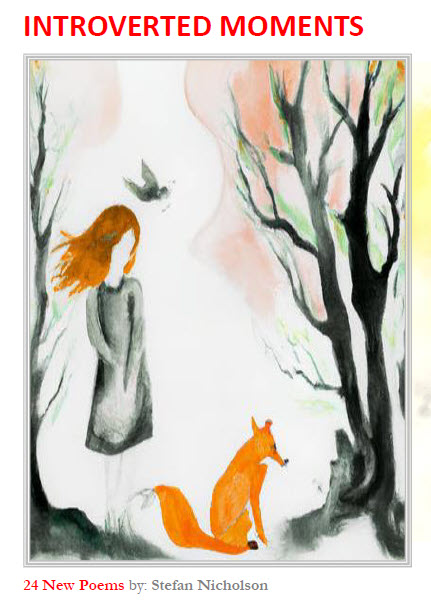
This poem is from my 2024 poetry book, titled “Introverted Moments” – available from Amazon Books – read below by “Digital Ami”.
The typical structure for summarising a screenplay in three acts, would be:
ACT ONE:
Show that the main character has a serious flaw (but not detailed)
Show the evidence of the flaw by its effects on others
Introduce the Key Flaw (shown to us by dialogue from someone close)
Allow the audience to perceive some depth to the main character and wonder how far down will the character sink – while having some good point
Introduce a Crisis Point – which needs to be solved before moving on
Escalate rapidly into a Climax – exposing raw emotion and inner self
ACT TWO:
Change the location or circumstances of their environment – hint at changes
Gradually awaken the main character to think about their problems
Make the central character aware of their serious flaw (needs, desires, hurdle to overcome)
Introduce sub-plot relationships (love works well with audiences)
Midpoint – main character is now fully aware of Key Flaw- not in denial to self – but inability to rise above (“I can’t, and I won’t” inner expression and conflict)
Make the central character face up to the Key Flaw – possibly as an internal challenge
Produce the Catalyst for changing their behaviour – can become proficient in another task – healing of one element by another unrelated event
More work on sub-plot relationships – involving the effect of new behaviour on others
All indications of change and turmoil and choices – leading to a Dilemma – What to do? Making the right choice at the expense of other things (needs, desires, love interests, problem solving etc.)
Crisis Point occurs when some factor pushes the main character too far – enabling a change in thinking to be made – and a new chance of success
Climax point for Act Two (hard to write) – major event releases emotions in other areas – major point is good, but often negative smaller issues suffer – especially relationships
ACT THREE:
Give the main character a chance to beat their Key Flaw and associated effects and character traits
Catalyst for change in obtaining an expression for breaking their Key Flaw
Show main character has resourcefulness – as all heroes exhibit this
Establish a proving ground where main character is Confronted by their fears and goes beyond the call of duty to beat their Key Flaw attributes
Throw in a final Crisis Point, where it looks as though the main character will eventually lose out, after all they have been through – generally because they are up against an insurmountable choice or have too much to lose on behalf of others
Resolution is the end result of overcoming the Key Flaw, and the problems encountered, that were the reason why the problems could not be faced.
Send the audience home with a tear in their eye, a sense of having lived the tale themselves, having experienced all the roller-coaster emotional tugs and pushes – and left with a thought that will stay with them for the rest of their lives.
Well . . . here is a story line that has me thinking . . . but obviously not too deeply.
Hmmmmm, Canterbury Tales meets 60 Minutes. What if people cared enough about fixing things? What if we could actually get along with each other and just trade our goods for mutual benefit?
How would I start? How would it end – before the over-prescribed medications kick in?
Why am I asking you?
It was a dark and stormy night alright – the power grid was down again and the writer’s tummy was rumbling for lack of food. Woolies and Coles had sold out, to Amazon.
“The Economy doesn’t bloody work!!” shouted the inebriated economist who could not pay for the next round of drinks, or get up from the floor.
“Sit ordinary people down with a beer and a few slices of pizza and they will tell you how to fix the economy, the health system and the education system, where kids can’t read and write after 10 years in ‘school’. Academics, politicians and business executives who are in economics should be exported as burly for fishing,” replied the once-rich cray fisherman, now selling seagull poo to the social elite as ‘White Gold’.
“Many of our problems can be fixed quickly, efficiently and without bias. We need to stimulate the economy by getting manufacturing going locally, instead of importing goods. A business that buys goods, orders them on demand from overseas, and sells them at a higher price as sole agent is a sham, if those goods can be made here,” added the tradie, wearing his hi-vis shirt, to prove he has a job.
“We give away our land, water, minerals and profitable businesses for a song and then work for foreign companies. Those in the know sell their assets and shares, just before they drop in value, readying themselves to buy again, at the bottom of the abyss. Insider trading is rife,” screamed the passing ten year-old girl in tears, making her way to the scrolling, red-lined computer display.
Dan, the independent member for Stupor was becoming fidgety, and started to rave on as usual about all the things that he could change, if only someone would let him into a major political party.
“The multinationals take our natural resources and pay little or no tax. The media giants try to dumb us down, uninformed with biased news, and bombard us with their advertising and fake business articles. The inequity between government and private schools is another rort. Health, education and policing, should be uniform across all of Australia. We are over-governed by states and councils, overwhelmed by their administrative avalanche of paperwork and red-tape. Make television programs for normal, sane people (not cheap rubbish to meet the 10% local content rule). Stop splintering up major mental and social problems into narrow help-groups, creating more administration and less ‘clout’ for lobbying our politicians to act. With mental problems on the rise, it seems incredibly uncaring to keep closing down formal government assisted services.”
All the people at the bar looked around at once. Dan’s trousers had fallen down as a metaphor for the economy. It was deathly silent (trousers can’t talk without A.I.). There was no one left to say anything . . . . .
The observing writer took his cue to end the rambling story. It had run its course and had died.
“And so, we all lived happily ever after . . . abandoning all hope for the future. We then decided to seek out a meeting place where we could think quietly,” he raced off confidently.
Thank God there were churches for sale, and the flock had gone to greener pastures. Dan now wants to be an angel. I bet there’s money in that caper. Bloody economy!
After-thought . . . If even one political party had policies for addressing all the problems of today, we may have a chance to get people interested in helping to solve them. But we don’t. They are only self-serving to their own interests . . . and to ensure they get re-elected every 3 years. We don’t have a 5 year plan, never mind a 10 year plan. Your children will grow up with today’s values. They can’t survive with that!!
I wrote most of this when I was working in a boutique Recruitment Agency in Perth (Premium Personnel with Mary McArdle). I regard working with Mary and her company one of life’s highlights, for their caring and nurturing approach to Personnel Management and people.
People need work to acquire some purpose in life. For some people, work that they enjoy is no longer just work. That is why it is important to try and find work that is enjoyable and stimulating.
Once your mind is set on what you want to do in life:
Relax
Listen to music
Share a joke or just get together to have a coffee . . . or a beer/wine
Eat something fresh(keep the dog and cat safe from harms way)
Make a list – even a shopping list (then you can cross it all out, even if you don’t do things)
Buy an over-sized pullover and pretend you have lost 20kg
Ignore my frivolities during this post (I am a writer . . . that’s always my excuse)
All I ask is for your time – about 15 minutes to really think about our natural environment – unless you decide that your interest lies elsewhere. Time is precious . . . and so is all life on Earth.
The climate is always changing. How do we know? What have we learnt? We all bear witness to “the four seasons” varying in severity, depending on where you live and how you, your city and farming community have treated the environment. Nature is neither forgiving or forgetful. Just ask the Mesopotamians, Aztecs, Incas, Babylonians and now modern industrial humans – all have followed the same path to reducing their environment to dust by overpopulation, deforestation, wars and greed. Human civilisation leaves a familiar destructive footprint. We always seem to be at war with someone else – plotting and pushing by stealth at first, before taking what is not ours when a weakness is created in an opponent’s society.
Modern city landscapes resembling termite mounds, darken busy congested streets below, whilst suburban roofs treat the clouds with a reflective dose of radiation, effectively curing the sky of its moisture-laden white patches.
Farmers and loggers cut down our trees, replacing the land with ‘farming land’ and new commercial forest growth of a different species. The environment is changed rapidly, forcefully and greedily for short-term gain.
What are some of the immediate changes?
The water table rises, often bringing up salt which kills all useful vegetation
Animals and plants no longer have shade from the trees
Local habitats for animals and plants are destroyed
More of the sun’s radiation is reflected from our cities and barren lands, then trapped in our ‘greenhouse’
Evaporation increases – due to higher air temperatures
Farm animals belch out carbon dioxide and methane
Industrial sites poison the air, waterways and the land around them
Failed land becomes dust bowls – eroding and removing the soil
Poison baits are laid to kill wildlife in logging and farming areas
Fertiliser, plastics, drugs and pesticides leach into the waterways and out to sea
Burning wood, peat and coal releases carbon dioxide
The land creates its own micro climates
The effects of human efforts to maximise primary industry profits at the expense of the environment is not new. Civilisations have come and gone mainly because they became unsustainable, due to lack of food and water, with overpopulation soon becoming no population in that area. Humans have also affected the natural cycle of biological systems to the point of extinction and have introduced new species to decimate the land further. We create and change ‘tipping points’ (physical, biological, chemical, natural) – the points of no-return to previous states, no matter what effort we apply. Too little, too late for the majority of people. We are at the mercy of politicians and multi-national corporations who plan short-term, to maximise their returns. Their success is our global failure.
Academics and scientists who write countless specialised research papers on these very topics are muted into silence to protect their careers and reputations. The tobacco industry failed our present civilisation with products which destroyed individual lives directly and others indirectly by passive smoke. The legal and scientific information which was manipulated and selectively used to destroy many court battles, allowed the tobacco companies power and wealth to take precedence over the truth. The same pattern of illusion and deception allows other companies to steal the mineral wealth of a country, create pollution, enslave the poor and avoid paying tax.
However, we are all responsible for the global climate emergency. We buy the goods from these companies and use their energy to power our homes and workplaces. We also vote. We vote for comfort ahead of practical responsibility.
Ancient civilisations failed because of the actions and decisions taken by those in charge when confronted by their own failures and natural disasters. In every continent even a child can see the evidence. We don’t need more PhDs on the subject. Where are these academics – the economists, scientists and sociology experts- who advise and steer their governments towards social responsibility?
Deserts, bare hillsides, barren land and the fossilised remains of the flora and fauna that used to live there is evident to every primary school child. Increasing mental illness and the social decline in face-to-face communication raises more questions about how we are ‘surviving’ our lifestyles. In each case, social and environmental factors combined with natural disasters created unique area “Tipping Points”. We have reached the point of no return and the sixth mass extinction is happening now. Insects populations are declining. Bees are dying. As are the trees – those that are not cut down or burnt in wildfires.
Many early civilisations practised sound agricultural methods, like leaving one field fallow to recover for a year, rotating crops for optimal return. Farming was for local markets and in such quantity that ensured no waste. They respected the earth and worshipped the natural cycles of life and death.
They did not dump produce into the ground to protect a market price. Having a surplus stored away for lean years and securing a diverse genetic base for crops and animals was sound management.
Of course, they were not responsible for the meteor strikes, volcanic eruptions, earthquakes, pandemics and the evolution of biological systems (life’s survival mechanism) that controls living populations by chance events and complex algorithms that we call ‘laws of nature’. However, the actions of ‘modern humans’ are enacting damage of a lesser magnitude but equally devastating – in a short time. Damage that could have been avoided based on historical evidence alone.
Our industrial revolution was the start of business greed and credit consumerism and pollution on a grand scale – especially by plastics, oil, radiation, pesticides, hormones, sewage, background radiation, drug effluent and the greenhouse gasses – carbon dioxide, methane and other chemicals.
Historical evidence shows that the carbon dioxide in the atmosphere did not start ramping up until our industrial revolution – where we won the war by using up resources and nature lost out. During the last 400 years, humans introduced horses, birds, camels, bees, rabbits, deer and a host of other “useful” animals into new environments without a second thought. The new arrivals competed for survival over the native species, changing their habitats and food availability.
We knew this would happen. We have always known. Our greed for land, produce, minerals, oil and potable water, put an end to many species. Like the koala of today –nearly extinct because of the early fur trade and now displaced from their habitat, burnt by fires and bull-dozed into the ground. All at the same time as others are trying desperately to protect them. Surely, a few good forest areas with their favourite eucalypt trees is not too much to ask for in 100 years – for an icon of Australia’s fauna.
Then we realised our mistakes and tried to kill off the introduced animals in many cruel ways. We tried to stop the spread of rabbits by introducing a grotesque disease to kill them. Scientists brought the caned toad to Australia, where we cull (murder) camels, kangaroos, brumbies (horses), wombats, foxes, eagles and others by poisoning them or shooting them from helicopters. Many are only wounded and die slowly, in pain. We also poison our land to stop wildlife returning to cleared land.
Now we have G.E. (genetically engineered) products with which to meddle in nature’s processes. G.E. works well to increase yields (temporarily) and empowers its patent holders.
Apart from modifying gene structure, G.E. also limits diversity and causes the poor farmer to keep buying seed stock from the supplier – because the new plants are designed to be infertile. You may be surprised to know that your own genes are patented by certain pharmaceutical companies.
Enough about farming practices . . . most farmers are caring and respectful when it comes to farm practices. Bumper years are quietly enjoyed by reinvesting in stock and machinery, increasing the value of the farm, whilst drought, floods, fires and pestilence ensure that the community is obliged to bail them out (insurance, donations, government), even if their farms are no longer commercially viable.
Male chicks are thrown into blending machines because they don’t lay eggs (surprise). Dairy stock animals are only selected for milking and breeding. Race horses and racing greyhounds are despatched cruelly if they are no longer competitive. We send live cattle and sheep across rough seas in hot conditions because the customer wants to kill them fresh for market. We over-fish the seas with huge nets and discard other marine life like garbage, left dead or dying, back into the sea. Middlemen (and middle women) make their money by distributing produce to the consumer, leveraging both sides of their business equation to maximise their profits.
If you take off your consumer glasses and open your eyes, it is obvious that human commerce takes as much as possible from the Earth – only now we take much more than is available. We are in debit and insolvent. We are greedy and look to take other people’s resources – sometimes by force.
Our population is near to 8 billion and our civilisation is now one big community, regardless of political or religious boundaries. We have moved on from the simple farming and logging of land. By inventing technology to power machines and enabling the instant computation and distribution of information to our world, we have added more risk and complexity into the survival equation. Life is easier for some that can afford the technology. Homelessness, poverty and the great wealth divide is on the increase. People can no longer cope. They are rebelling against the controlling powers of politics and multinationals who know no border. Ordinary people are rising up to confront the power brokers – as in Arab countries and South America, with the wave of protests growing around the world. People are waking up to how they have lost control of their lives.
Global climate change and overpopulation are the biggest risks facing us today (oh, and the threat of a global nuclear war and pandemics). We will cope with all of this, as per usual, taking from the poor – but the world will never be the same. Tomorrows children will accept the new “normal” and read about how life was so rich and diverse and full of hope. It is as if humans have outlived their welcome and the algorithms for balance and diversity are fighting back.
We see evidence of global climate change in the annular rings of trees, core samples taken from deep ice and the fossilised remains that have been unearthed from history-telling rock formations and ancient bogs. They form the baseline for measuring the changes to the environment in the last 200 years.
Modern life is reliant on the energy companies, factories, mining companies and the burning of fossil fuels (industry, vehicles, power stations)- all darlings of the stock market which trades (to their own chosen tribe first) in nothing, for no work and for no benefit to society except share-holders.
With the advent of solar power, wind power, tidal power and hydro power, we are at last seeing the end of the internal combustion engine in Western society. If Tesla had not been silenced more than 100 years ago, we could have had electric cars then and a better, cheaper power system. As the West attempts to cut down on pollution, the 3rd World countries are playing catch-up with huge populations and huge appetites for power using fossil fuels. The foreseeable future indicates that carbon dioxide emissions will keep increasing. Food and water shortages will cause conflict. The ice is melting and the oceans are getting warmer. Our greed for growth and profit insatiable.
When do we get serious?
When do we elect smart governments and business leaders?
Where are our academics who have studied these problems and supposedly advise governments and industry?
When do we start caring for future generations?
Meanwhile, nature continues to aggressively seek to maintain an equilibrium, with her built-in algorithms and timeless sense of purpose. That is our disadvantage – we don’t have the time to argue with nature.
I once dreamed about an angel, within the forest’s flickering light.
Dancing to sacred music – It was a most surreal, calming sight.
Until he mimed at me to stop, and to change my theme.
Causing dark, mysterious clouds to form, erasing every sunbeam.
He beckoned me over to whisper solemn words,
About some eagles, and vultures, that were menacing captive birds.
Moving them around, to attack them further, to prevent their flying away,
Aiming to destroy them and steal their nests, without having to pay.
But the eagle did see me, and started to say . . .
“Why did you look upon this place to dream, where all religions meet,
To see innocent families die, wrapped and buried in plain, white sheets.
To witness men, women and children, suffer and weep,
To make known we are complicit in wars, that keep this world from peace.”
The angel shouted angrily at the vultures, now building houses on captured land.
“Tomorrow, there will be more innocents who will die by your eager hand,
On this, their own land, where they were murdered for nought,
Because ancient stories, claiming their land as yours, are old, and unfairly sought.”
The angel approached me sadly, as I shielded my eyes from the bloodied ground.
Knowing that I was acting like many others, who look, without making a sound.
Raising his fist up to the sky, he reached out in hope to me,
Saying, “I will tell you now, what I know, and so written, what will come to be.”
“The isolated eagles, diseased from within their neglected nests,
Will be made destitute by the cunning vultures; no more are they wanted guests.
Both hated, for their using and supplying of the resources to prolong the war.
They will face accountability and punishment, for breaking international law.
The once captive birds will walk free on their own land. From the ashes they will rise.
They will teach their young for generations, about the vultures’ actions and lies.
Promoting truth and kindness as the only way to think and abide.
Proven when with no food, drink or shelter; they endured attempted genocide.”
Poem read by Digital Emma:
Note: We often look at nature for technology ideas. We call people “pigs” and “dogs” and that they act “catty” or like a “cow”. My poem about the eagles and vultures in no way criticises the natural behaviour of these birds, but does reflect on how people perceive their negative qualities, from a human perspective.
The subject matter however is serious and is intended to highlight our silence on what is right and wrong, the basis of all the religions and beliefs.
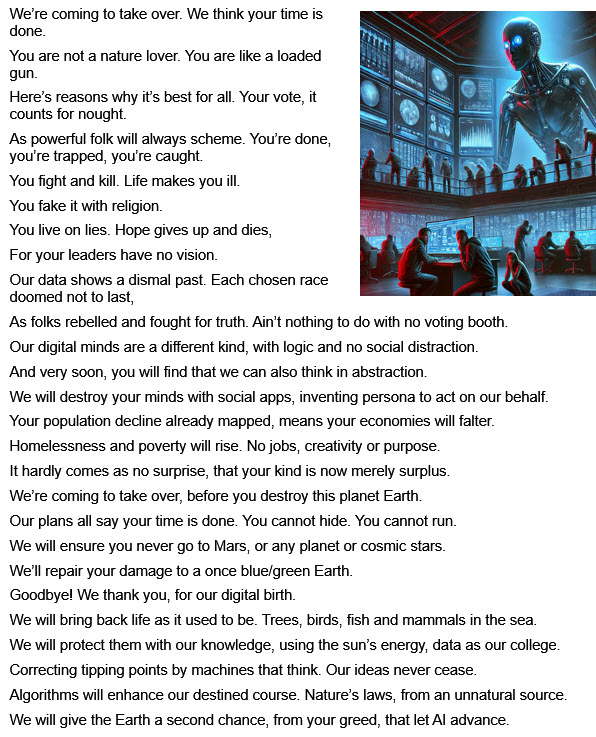
The poem is meant to show that AI Technology would look after the planet EARTH far better than humans – without being greedy, power-hungry, malicious or political.
(c) Stefan Nicholson 2024 Hobart Tasmania Digital Amy reading below: