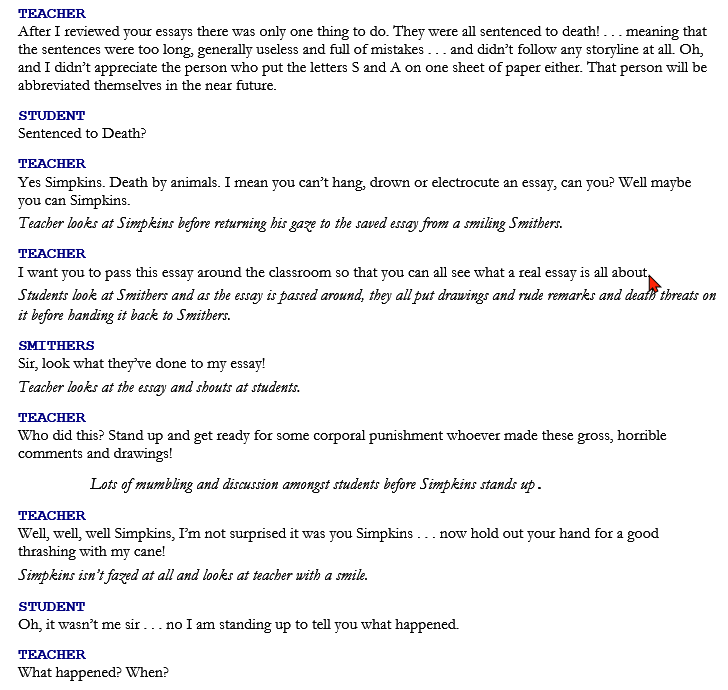
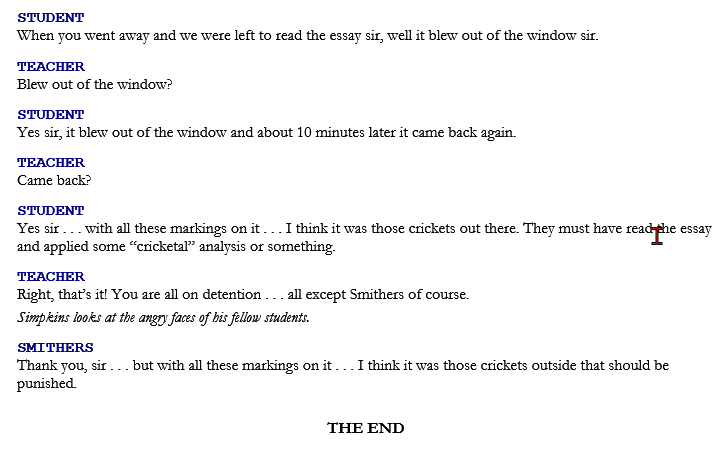
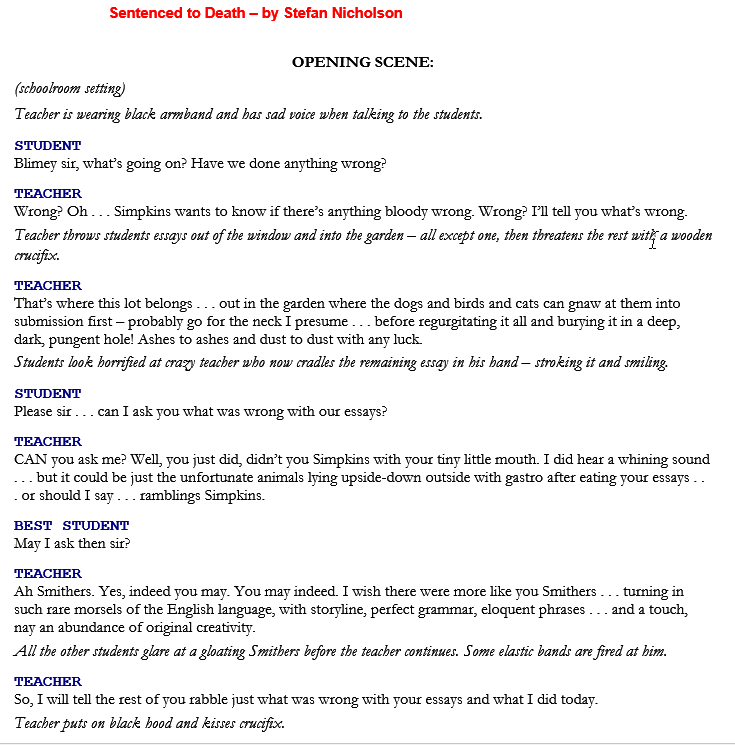
A Skit about School Essays

My blog for this week is on the notion of abstract comedy. This involves an interplay within the story-line, hidden meanings and imagined mannerisms of the characters. The example given is from my book, “Short Comedy Routines for Novices” (available from Amazon and Kindle). The book contains 46 skits for young comedians, to practice delivery, timing and facial expressions – in a setting with minimal props.

The example is generally part of the continuous banter which occurs throughout a typical half-hour comedy series.

Example of a Comedy Script

Cool Cat” – (c) Stefan Nicholson 2015 Tasmania

OPENING SCENE:

(James is playing “Clair de Lune” on piano which has a bust of Debussy on top – His cat is sitting next to the bust)

Eric who is not very sharp, enters the room and looks unaware of his environment and has a blank look.

Eric

Wow man . . . who wrote that cool music? . . . It’s all floaty and surreal man.

James

(Points to the composer’s bust on piano, next to the cat)

Debussy. Yeah it sounds like some random falling of leaves on a winter’s night.

Eric

(looking at the cat which stretches out its paws)

Are you messing with me man. Is that the dude?

James

No kidding man . . . Claude Debussy. A French composer, who wrote it one night while looking at the moon.

Eric

(looking at the cat and talking slowly)

Well done Claude, that is a very nice piece of music . . . if you understand English man.

James

Good grief Eric . . . I was pointing at the composer’s bust.

Eric

Wow, sorry man for missing the clue.  So sorry Claudette, for making a huge mistake with the boobs and all.

(James crashes his head into the keyboard and bangs his hands up and down on the keys)

Eric

Wow man . . . is that another one of the pussy’s compositions?

James

Are you planning to have children in the future Eric . . . because they would probably smother you while you were sleeping, around the age of three when they would surely realise that cats DO NOT compose music!

Eric

But what about . . . ?

James

Don’t you ever mention “Cats” the musical in front of my cat . . . you may give it grandiose ideas.

THE END
How to write a SCREENPLAY

The typical structure for summarising a screenplay in three acts, would be:

ACT ONE:

  • Show that the main character has a serious flaw (but not detailed)
  • Show the evidence of the flaw by its effects on others
  • Introduce the Key Flaw (shown to us by dialogue from someone close)
  • Allow the audience to perceive some depth to the main character and wonder how far down will the character sink – while having some good point
  • Introduce a Crisis Point – which needs to be solved before moving on
  • Escalate rapidly into a Climax – exposing raw emotion and inner self

ACT TWO:

  • Change the location or circumstances of their environment – hint at changes
  • Gradually awaken the main character to think about their problems
  • Make the central character aware of their serious flaw (needs, desires, hurdle to overcome)
  • Introduce sub-plot relationships (love works well with audiences)
  • Midpoint – main character is now fully aware of Key Flaw- not in denial to self – but inability to rise above (“I can’t, and I won’t” inner expression and conflict)
  • Make the central character face up to the Key Flaw – possibly as an internal challenge
  • Produce the Catalyst for changing their behaviour – can become proficient in another task – healing of one element by another unrelated event
  • More work on sub-plot relationships – involving the effect of new behaviour on others
  • All indications of change and turmoil and choices – leading to a Dilemma – What to do?  Making the right choice at the expense of other things (needs, desires, love interests, problem solving etc.)
  • Crisis Point occurs when some factor pushes the main character too far – enabling a change in thinking to be made – and a new chance of success
  • Climax point for Act Two (hard to write) – major event releases emotions in other areas – major point is good, but often negative smaller issues suffer – especially relationships

ACT THREE:

  • Give the main character a chance to beat their Key Flaw and associated effects and character traits
  • Catalyst for change in obtaining an expression for breaking their Key Flaw
  • Show main character has resourcefulness – as all heroes exhibit this
  • Establish a proving ground where main character is Confronted by their fears and goes beyond the call of duty to beat their Key Flaw attributes
  • Throw in a final Crisis Point, where it looks as though the main character will eventually lose out, after all they have been through – generally because they are up against an insurmountable choice or have too much to lose on behalf of others
  • Resolution is the end result of overcoming the Key Flaw, and the problems encountered, that were the reason why the problems could not be faced.
  • Send the audience home with a tear in their eye, a sense of having lived the tale themselves, having experienced all the roller-coaster emotional tugs and pushes – and left with a thought that will stay with them for the rest of their lives.

(c) Stefan Nicholson 2009