Little Spaceman

(c) Stefan Nicholson – from Introverted Moments (on Amazon)
(c) Stefan Nicholson – from Introverted Moments (on Amazon)
The Writing of History and Biographies
I am a great fan of Lewis Carroll – the mathematician who became a writer of children’s books and nonsense poetry. He observed the world around him, and applied logic to show that what we see, and our understanding of it, depends on your perspective. So too, with the writing of history: people, places and times.
Wearing his hat for a few minutes, I would have to conclude, that everything that is not most useful, is necessarily less useful) – an interesting question for this week. And yet, if anything is useful, it is just that – otherwise it would be useless. Say that fast, three times.
From historical evidence and sequence of events, a biographer presents the logic of the true event, and the story teller within, moulds this into the storyline – or it can work the other way around. Biography is the true story – as can be reasonably told based on fact and reasoning, notwithstanding that some biographers lie through their teeth.
So, how do you write about history?
Where to go from here with the writing of your next book?
“That depends a good deal on where you want to get to,” said the Cat
“I don’t much care where ——“, said Alice.
“Then it doesn’t matter which way you go,” said the Cat
“—- so long as I get somewhere,” Alice added as an explanation.
“Oh, you’re sure to do that,” said the Cat, “if you only walk long enough”
(excerpt from Lewis Carroll’s “Alice in Wonderland”)
I am going to have a long thoughtful walk, and plan out another interesting historical work. I lived the life of Adam Lindsay Gordon for long enough to share his experiences, when I wrote a poem for the Adam Lindsay Gordon Association – and came out of it a wiser man – and second prize winner.
Best regards to everyone. I hope to be reading your published works in the near future.
Another poem from my “Introverted Moments” book, available on Amazon.
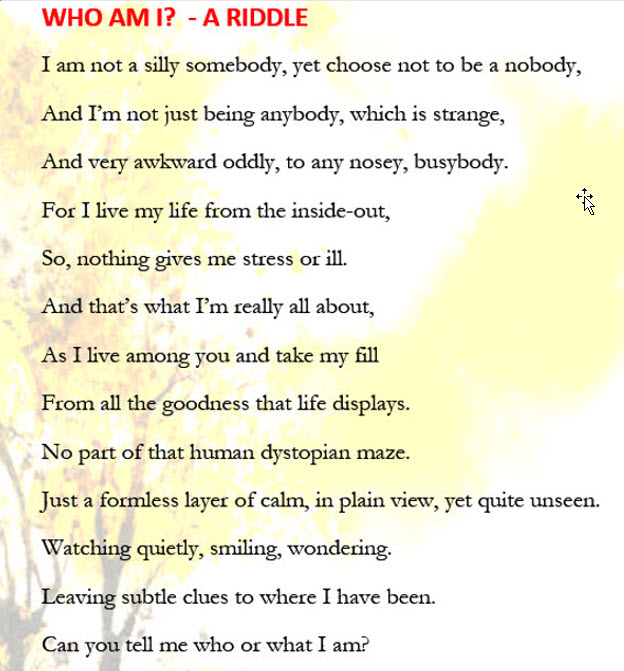
Herein is a clue to the answer.
Onward and upward to reach the summit of possibilities.
Perhaps a peek into the future?
Everyone must think they can solve the riddle.
The answer is HOPE
Identity is the individuality of a person – their self, and their uniqueness. Their uniqueness is displayed to the external world through personality, character, and specifications as if choosing from a list of attributes.
A photograph identifies a person based on physical attributes. We can also identify people by the sound of their voices, by tell-tale gestures and mannerisms, and sometimes by how others describe them.
A writer may be identified by their style of writing, and what they write about.
Identification seems to work the other way around. We ask what sort of person would have certain attributes. We erroneously assume that all people with those attributes, act and think the same. Identification is the cataloguing of attributes, to act as a filter for our human necessity for labeling. We seem to label everything, in a desire to understand the whole, while ignoring the individual. We determine what sort of writer would write about certain topics – by apparent attributes but not by knowing their real persona.
As an example of identification: When I was driving a maxi-taxi, people often slotted me into that one role. When I was in recruitment, job applicants with multiple skills would be labelled and filed away with one job specification, instead of the multiple skills and previous varied jobs and study.
So, what is more important – and for whom?
For a non-fiction writer: Identification is equally as important as the identity of the author. Do they qualify for expertise in research and analysing scenarios of events that happened? Do they have inside information as to what it is like to belong and have identification for belief? Have they presented the “facts” without bias or imagination?
In writing fiction: Well, anything is possible, and even wrong facts may actually be a twist on the real thing. Imagining what the writer is like in person is sometimes impossible. This is the nature of creative writing. Imagination is the key ingredient for creating a tantalising plot.
Personally, as a writer, I would just like to be identified as having the right skills for the work I do. My identity is my persona – my identification merely a catalogue of my belongings and the labels that people assume to fit, based on my attributes.
Also, we do not often wonder about the writer’s life when reading their book. When we read, we become the writer, within our imagination and feelings, with all our positive and negative interpretations of the original writer’s work and its many possible meanings.
Two opposite sayings indicate how identification can be misleading and coerced by myth:
To finish, with another saying:
“Cool Cat” – (c) Stefan Nicholson 2015 Tasmania
OPENING SCENE:
(James is playing “Clair de Lune” on piano which has a bust of Debussy on top – His cat is sitting next to the bust)
Eric who is not very sharp, enters the room and looks unaware of his environment and has a blank look.
Eric
Wow man . . . who wrote that cool music? . . . It’s all floaty and surreal man.
James
(Points to the composer’s bust on piano, next to the cat)
Debussy. Yeah it sounds like some random falling of leaves on a winter’s night.
Eric
(looking at the cat which stretches out its paws)
Are you messing with me man. Is that the dude?
James
No kidding man . . . Claude Debussy. A French composer, who wrote it one night while looking at the moon.
Eric
(looking at the cat and talking slowly)
Well done Claude, that is a very nice piece of music . . . if you understand English man.
James
Good grief Eric . . . I was pointing at the composer’s bust.
Eric
Wow, sorry man for missing the clue. So sorry Claudette, for making a huge mistake with the boobs and all.
(James crashes his head into the keyboard and bangs his hands up and down on the keys)
Eric
Wow man . . . is that another one of the pussy’s compositions?
James
Are you planning to have children in the future Eric . . . because they would probably smother you while you were sleeping, around the age of three when they would surely realise that cats DO NOT compose music!
Eric
But what about . . . ?
James
Don’t you ever mention “Cats” the musical in front of my cat . . . you may give it grandiose ideas.
THE END
The typical structure for summarising a screenplay in three acts, would be:
ACT ONE:
ACT TWO:
ACT THREE:
(c) Stefan Nicholson 2009
 Stefan A Nicholson (Tasmania)