My review of a piece of sculpture I admire, with reflections on the language used:
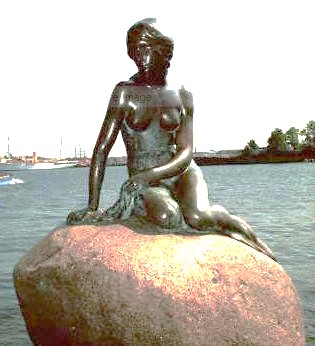
One classical sculpture that I admire, for its beauty and romantic history, is the ‘Den Lille Havrue’.
Originating from an 1837 fairy tale about a 15 year old girl, commissioned by a beer baron to bear the adult face of his obsession (and beautifully sculptured in bronze in 1912), the statue was finally unveiled in 1913.
Sitting atop a rock, naked and alone, the young woman looks across to the ruinous land, thinking about the waters below, where she spent her childhood years, in a world underneath the sea.
The background harbour forms an oppressive barrier, adding more gloom to the tale, where she traded her singing voice (by removal of her tongue), for a pair of human legs – so that she could marry the prince, whom she had earlier saved from a shipwreck.
It is a sad story, because she would never marry the prince.
She was destined to never be able to live under the sea again, and when she walked on the land, each step produced unbearable pain.
Most folklore portrays mermaids as haters of all men, luring sailors to jump into the sea, to drown. Hans Christian Anderson changed the tables, portraying the mermaid as a heroine, and the generally accepted handsome prince as a ‘rattus rattus marinus’.
Every year, millions of people visit ‘The Little Mermaid” (English translation) in Copenhagen, Denmark, for she is now a symbol of national strength in the face of adversity, and an inspiration for children with pure imagination.
The sculptor, Edvard Erichsen reproduced the face of Ellen Price, a solo dancer in the ballet ‘The Little Mermaid’, faithfully into the sculpture, as brewer Carl Jacobsen (Carlsberg Brewery) had commissioned the work. The nude modelling had to be passed on to Erichsen’s wife, as Price was reluctant to show more than her face to the sculptor.
The statue weighs 175kg, and although surviving wars and the Great Depression, modern vandals have not been so kind to her. One severed arm, two decapitations and several attempts to paint her red and fitting her with a bras, have taken their toll. Visitors have climbed on top of her, wearing away some of the bronze, leaving her a dark and faded brown – unless highlighted by camera flashlight. She will soon be imprisoned behind a security fence, adding another atrocity to the memorial of a famous heroine.
Erichsen froze the statue into a metamorphosis, providing both legs and fish tail – contrary to the Andersen story of having either one or the other. The purpose was to define the meaning of the statue. The best time to approach the statue, is when the weather is grey and overcast – bringing out more feelings of isolation.
She sits side-saddle on the rock, her small 1.6 metre frame disappointing many. The statue is easily accessible from the front and sides, allowing an appreciation of the sculptor’s portrayal of the living form, especially seen through the arched back. The flowing tail hugs the downward slope of the ovoid rock.
Her stooped pose conveys the feeling of despair. And yet, with her weight resting on one arm, and her other hand reaching across her thigh, there seems to be hope, that her waiting may bring sight of her lover. Walking around the statue on the shore, the history and meaning of her plight seems real.
There is a feeling of loss that only increases when imagining the statue being unveiled in 1913 – in full splendour, shining with fine feature, and revealing her wonderful face.
(c) Stefan Nicholson 2009
Reflection on language used: By necessity the language is emotional, historical and descriptive. The art and its history are eternally bound together through folklore and expectations of the audience (readers of the book, and lovers of sculpture).
The subject needs a longer review because of its complexity – yet for such a simple study, of a girl sitting on a rock.

 Stefan A Nicholson (Tasmania)