My review of a piece of sculpture I admire, with reflections on the language used:
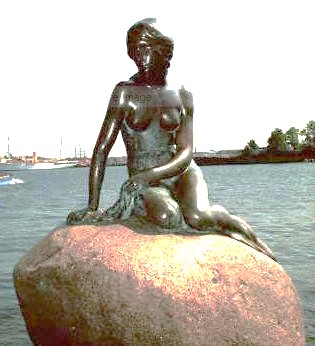
One classical sculpture that I admire, for its beauty and romantic history, is the ‘Den Lille Havrue’.
Originating from an 1837 fairy tale about a 15 year old girl, commissioned by a beer baron to bear the adult face of his obsession (and beautifully sculptured in bronze in 1912), the statue was finally unveiled in 1913.
Sitting atop a rock, naked and alone, the young woman looks across to the ruinous land, thinking about the waters below, where she spent her childhood years, in a world underneath the sea.
The background harbour forms an oppressive barrier, adding more gloom to the tale, where she traded her singing voice (by removal of her tongue), for a pair of human legs – so that she could marry the prince, whom she had earlier saved from a shipwreck.
It is a sad story, because she would never marry the prince.
She was destined to never be able to live under the sea again, and when she walked on the land, each step produced unbearable pain.
Most folklore portrays mermaids as haters of all men, luring sailors to jump into the sea, to drown. Hans Christian Anderson changed the tables, portraying the mermaid as a heroine, and the generally accepted handsome prince as a ‘rattus rattus marinus’.
Every year, millions of people visit ‘The Little Mermaid” (English translation) in Copenhagen, Denmark, for she is now a symbol of national strength in the face of adversity, and an inspiration for children with pure imagination.
The sculptor, Edvard Erichsen reproduced the face of Ellen Price, a solo dancer in the ballet ‘The Little Mermaid’, faithfully into the sculpture, as brewer Carl Jacobsen (Carlsberg Brewery) had commissioned the work. The nude modelling had to be passed on to Erichsen’s wife, as Price was reluctant to show more than her face to the sculptor.
The statue weighs 175kg, and although surviving wars and the Great Depression, modern vandals have not been so kind to her. One severed arm, two decapitations and several attempts to paint her red and fitting her with a bras, have taken their toll. Visitors have climbed on top of her, wearing away some of the bronze, leaving her a dark and faded brown – unless highlighted by camera flashlight. She will soon be imprisoned behind a security fence, adding another atrocity to the memorial of a famous heroine.
Erichsen froze the statue into a metamorphosis, providing both legs and fish tail – contrary to the Andersen story of having either one or the other. The purpose was to define the meaning of the statue. The best time to approach the statue, is when the weather is grey and overcast – bringing out more feelings of isolation.
She sits side-saddle on the rock, her small 1.6 metre frame disappointing many. The statue is easily accessible from the front and sides, allowing an appreciation of the sculptor’s portrayal of the living form, especially seen through the arched back. The flowing tail hugs the downward slope of the ovoid rock.
Her stooped pose conveys the feeling of despair. And yet, with her weight resting on one arm, and her other hand reaching across her thigh, there seems to be hope, that her waiting may bring sight of her lover. Walking around the statue on the shore, the history and meaning of her plight seems real.
There is a feeling of loss that only increases when imagining the statue being unveiled in 1913 – in full splendour, shining with fine feature, and revealing her wonderful face.
(c) Stefan Nicholson 2009
Reflection on language used: By necessity the language is emotional, historical and descriptive. The art and its history are eternally bound together through folklore and expectations of the audience (readers of the book, and lovers of sculpture).
The subject needs a longer review because of its complexity – yet for such a simple study, of a girl sitting on a rock.
I am a great fan of Lewis Carroll – the mathematician who became a writer of children’s books and nonsense poetry. He observed the world around him, and applied logic to show that what we see, and our understanding of it, depends on your perspective. So too, with the writing of history: people, places and times.
Wearing his hat for a few minutes, I would have to conclude, that everything that is not most useful, is necessarily less useful) – an interesting question for this week. And yet, if anything is useful, it is just that – otherwise it would be useless. Say that fast, three times.
From historical evidence and sequence of events, a biographer presents the logic of the true event, and the story teller within, moulds this into the storyline – or it can work the other way around. Biography is the true story – as can be reasonably told based on fact and reasoning, notwithstanding that some biographers lie through their teeth.
So, how do you write about history?
I have learnt that writing history demands the mastery of being able to tell a story, while simultaneously telling the truth in critical areas. False account and erroneous fact will be picked up by the critic. Reputation is closely linked to accuracy and meeting audience expectations. The facts of history may be consciously or unconsciously distorted by bias and/or malice – depending on the context of the events by the writer.
Historical fiction is the incorporation of real historical events and figures, into a story line, whereby the setting must be true to the reality of the past. Sometimes the characters are themselves, and at other times, generally when sensitivities and legalities are required, the characters may have new names – or nick-names.
A hard-nosed journalist will write the historical work according to the facts. The writer of a biography or autobiography will write a memoir or complete life-story, adding their own bias of thoughts and feelings. An historical fiction writer will use imagination and lateral thinking to work in with history, and build up an entertaining, action-packed story, using story board technique and character role play.
I have learnt how to gather information from linked sources, as well as family and friends of family. We have each recounted the affect that events may have on the history of the family – notable migration, marriages, deaths and wars.
Hidden stories, secret facts, and sensitivities within the family history, must be explored, debated and effectively dealt with to ensure a “reasonable” and ethical outcome for all parties. The possibility of sitting on a story, to synchronise the release of truth, while avoiding litigation and copyright issues, has been well rewarded many times. A good lawyer should always provide the ultimate advice on such matters.
Visuals, choosing fiction writing and acknowledging the requirement to tell a story at its best, taught me that the story-line and audience participation is of prime importance. The audience becomes the writerly-reader – adding another dimension to the existing work. Visuals may be used to reduce some of the descriptive embellishment – allowing photos and graphics to “show” by example. This enhances the concise narrative and dialogue, to create a mood or historical atmosphere, so that the reader’s imagination is encouraged – rather than being lectured to.
Finally, I have learnt through the experiences of fellow students, lecturers, authors and supporting readings, that there is both pleasure and pressure experienced by the historical writer. Whether you choose to write imaginative historical fiction, or engage in rigorous and academically precise researching for biography, or classical historical works, there are expectations of sensibility and much research of material.
Where to go from here with the writing of your next book?
“That depends a good deal on where you want to get to,” said the Cat
“I don’t much care where ——“, said Alice.
“Then it doesn’t matter which way you go,” said the Cat
“—- so long as I get somewhere,” Alice added as an explanation.
“Oh, you’re sure to do that,” said the Cat, “if you only walk long enough”
(excerpt from Lewis Carroll’s “Alice in Wonderland”)
I am going to have a long thoughtful walk, and plan out another interesting historical work. I lived the life of Adam Lindsay Gordon for long enough to share his experiences, when I wrote a poem for the Adam Lindsay Gordon Association – and came out of it a wiser man – and second prize winner.
Best regards to everyone. I hope to be reading your published works in the near future.
Identity is the individuality of a person – their self, and their uniqueness. Their uniqueness is displayed to the external world through personality, character, and specifications as if choosing from a list of attributes.
A photograph identifies a person based on physical attributes. We can also identify people by the sound of their voices, by tell-tale gestures and mannerisms, and sometimes by how others describe them.
A writer may be identified by their style of writing, and what they write about.
Identification seems to work the other way around. We ask what sort of person would have certain attributes. We erroneously assume that all people with those attributes, act and think the same. Identification is the cataloguing of attributes, to act as a filter for our human necessity for labeling. We seem to label everything, in a desire to understand the whole, while ignoring the individual. We determine what sort of writer would write about certain topics – by apparent attributes but not by knowing their real persona.
As an example of identification: When I was driving a maxi-taxi, people often slotted me into that one role. When I was in recruitment, job applicants with multiple skills would be labelled and filed away with one job specification, instead of the multiple skills and previous varied jobs and study.
So, what is more important – and for whom?
For a non-fiction writer: Identification is equally as important as the identity of the author. Do they qualify for expertise in research and analysing scenarios of events that happened? Do they have inside information as to what it is like to belong and have identification for belief? Have they presented the “facts” without bias or imagination?
In writing fiction: Well, anything is possible, and even wrong facts may actually be a twist on the real thing. Imagining what the writer is like in person is sometimes impossible. This is the nature of creative writing. Imagination is the key ingredient for creating a tantalising plot.
Personally, as a writer, I would just like to be identified as having the right skills for the work I do. My identity is my persona – my identification merely a catalogue of my belongings and the labels that people assume to fit, based on my attributes.
Also, we do not often wonder about the writer’s life when reading their book. When we read, we become the writer, within our imagination and feelings, with all our positive and negative interpretations of the original writer’s work and its many possible meanings.
Two opposite sayings indicate how identification can be misleading and coerced by myth:
“Don’t judge a book by its cover”; and
“Birds of a feather flock together”.
To finish, with another saying:
“To really understand someone, just walk a mile in their shoes”.
All I ask is for your time – about 15 minutes to really think about our natural environment – unless you decide that your interest lies elsewhere. Time is precious . . . and so is all life on Earth.
The climate is always changing. How do we know? What have we learnt? We all bear witness to “the four seasons” varying in severity, depending on where you live and how you, your city and farming community have treated the environment. Nature is neither forgiving or forgetful. Just ask the Mesopotamians, Aztecs, Incas, Babylonians and now modern industrial humans – all have followed the same path to reducing their environment to dust by overpopulation, deforestation, wars and greed. Human civilisation leaves a familiar destructive footprint. We always seem to be at war with someone else – plotting and pushing by stealth at first, before taking what is not ours when a weakness is created in an opponent’s society.
Modern city landscapes resembling termite mounds, darken busy congested streets below, whilst suburban roofs treat the clouds with a reflective dose of radiation, effectively curing the sky of its moisture-laden white patches.
Farmers and loggers cut down our trees, replacing the land with ‘farming land’ and new commercial forest growth of a different species. The environment is changed rapidly, forcefully and greedily for short-term gain.
What are some of the immediate changes?
The water table rises, often bringing up salt which kills all useful vegetation
Animals and plants no longer have shade from the trees
Local habitats for animals and plants are destroyed
More of the sun’s radiation is reflected from our cities and barren lands, then trapped in our ‘greenhouse’
Evaporation increases – due to higher air temperatures
Farm animals belch out carbon dioxide and methane
Industrial sites poison the air, waterways and the land around them
Failed land becomes dust bowls – eroding and removing the soil
Poison baits are laid to kill wildlife in logging and farming areas
Fertiliser, plastics, drugs and pesticides leach into the waterways and out to sea
Burning wood, peat and coal releases carbon dioxide
The land creates its own micro climates
The effects of human efforts to maximise primary industry profits at the expense of the environment is not new. Civilisations have come and gone mainly because they became unsustainable, due to lack of food and water, with overpopulation soon becoming no population in that area. Humans have also affected the natural cycle of biological systems to the point of extinction and have introduced new species to decimate the land further. We create and change ‘tipping points’ (physical, biological, chemical, natural) – the points of no-return to previous states, no matter what effort we apply. Too little, too late for the majority of people. We are at the mercy of politicians and multi-national corporations who plan short-term, to maximise their returns. Their success is our global failure.
Academics and scientists who write countless specialised research papers on these very topics are muted into silence to protect their careers and reputations. The tobacco industry failed our present civilisation with products which destroyed individual lives directly and others indirectly by passive smoke. The legal and scientific information which was manipulated and selectively used to destroy many court battles, allowed the tobacco companies power and wealth to take precedence over the truth. The same pattern of illusion and deception allows other companies to steal the mineral wealth of a country, create pollution, enslave the poor and avoid paying tax.
However, we are all responsible for the global climate emergency. We buy the goods from these companies and use their energy to power our homes and workplaces. We also vote. We vote for comfort ahead of practical responsibility.
Ancient civilisations failed because of the actions and decisions taken by those in charge when confronted by their own failures and natural disasters. In every continent even a child can see the evidence. We don’t need more PhDs on the subject. Where are these academics – the economists, scientists and sociology experts- who advise and steer their governments towards social responsibility?
Deserts, bare hillsides, barren land and the fossilised remains of the flora and fauna that used to live there is evident to every primary school child. Increasing mental illness and the social decline in face-to-face communication raises more questions about how we are ‘surviving’ our lifestyles. In each case, social and environmental factors combined with natural disasters created unique area “Tipping Points”. We have reached the point of no return and the sixth mass extinction is happening now. Insects populations are declining. Bees are dying. As are the trees – those that are not cut down or burnt in wildfires.
Many early civilisations practised sound agricultural methods, like leaving one field fallow to recover for a year, rotating crops for optimal return. Farming was for local markets and in such quantity that ensured no waste. They respected the earth and worshipped the natural cycles of life and death.
They did not dump produce into the ground to protect a market price. Having a surplus stored away for lean years and securing a diverse genetic base for crops and animals was sound management.
Of course, they were not responsible for the meteor strikes, volcanic eruptions, earthquakes, pandemics and the evolution of biological systems (life’s survival mechanism) that controls living populations by chance events and complex algorithms that we call ‘laws of nature’. However, the actions of ‘modern humans’ are enacting damage of a lesser magnitude but equally devastating – in a short time. Damage that could have been avoided based on historical evidence alone.
Our industrial revolution was the start of business greed and credit consumerism and pollution on a grand scale – especially by plastics, oil, radiation, pesticides, hormones, sewage, background radiation, drug effluent and the greenhouse gasses – carbon dioxide, methane and other chemicals.
Historical evidence shows that the carbon dioxide in the atmosphere did not start ramping up until our industrial revolution – where we won the war by using up resources and nature lost out. During the last 400 years, humans introduced horses, birds, camels, bees, rabbits, deer and a host of other “useful” animals into new environments without a second thought. The new arrivals competed for survival over the native species, changing their habitats and food availability.
We knew this would happen. We have always known. Our greed for land, produce, minerals, oil and potable water, put an end to many species. Like the koala of today –nearly extinct because of the early fur trade and now displaced from their habitat, burnt by fires and bull-dozed into the ground. All at the same time as others are trying desperately to protect them. Surely, a few good forest areas with their favourite eucalypt trees is not too much to ask for in 100 years – for an icon of Australia’s fauna.
Then we realised our mistakes and tried to kill off the introduced animals in many cruel ways. We tried to stop the spread of rabbits by introducing a grotesque disease to kill them. Scientists brought the caned toad to Australia, where we cull (murder) camels, kangaroos, brumbies (horses), wombats, foxes, eagles and others by poisoning them or shooting them from helicopters. Many are only wounded and die slowly, in pain. We also poison our land to stop wildlife returning to cleared land.
Now we have G.E. (genetically engineered) products with which to meddle in nature’s processes. G.E. works well to increase yields (temporarily) and empowers its patent holders.
Apart from modifying gene structure, G.E. also limits diversity and causes the poor farmer to keep buying seed stock from the supplier – because the new plants are designed to be infertile. You may be surprised to know that your own genes are patented by certain pharmaceutical companies.
Enough about farming practices . . . most farmers are caring and respectful when it comes to farm practices. Bumper years are quietly enjoyed by reinvesting in stock and machinery, increasing the value of the farm, whilst drought, floods, fires and pestilence ensure that the community is obliged to bail them out (insurance, donations, government), even if their farms are no longer commercially viable.
Male chicks are thrown into blending machines because they don’t lay eggs (surprise). Dairy stock animals are only selected for milking and breeding. Race horses and racing greyhounds are despatched cruelly if they are no longer competitive. We send live cattle and sheep across rough seas in hot conditions because the customer wants to kill them fresh for market. We over-fish the seas with huge nets and discard other marine life like garbage, left dead or dying, back into the sea. Middlemen (and middle women) make their money by distributing produce to the consumer, leveraging both sides of their business equation to maximise their profits.
If you take off your consumer glasses and open your eyes, it is obvious that human commerce takes as much as possible from the Earth – only now we take much more than is available. We are in debit and insolvent. We are greedy and look to take other people’s resources – sometimes by force.
Our population is near to 8 billion and our civilisation is now one big community, regardless of political or religious boundaries. We have moved on from the simple farming and logging of land. By inventing technology to power machines and enabling the instant computation and distribution of information to our world, we have added more risk and complexity into the survival equation. Life is easier for some that can afford the technology. Homelessness, poverty and the great wealth divide is on the increase. People can no longer cope. They are rebelling against the controlling powers of politics and multinationals who know no border. Ordinary people are rising up to confront the power brokers – as in Arab countries and South America, with the wave of protests growing around the world. People are waking up to how they have lost control of their lives.
Global climate change and overpopulation are the biggest risks facing us today (oh, and the threat of a global nuclear war and pandemics). We will cope with all of this, as per usual, taking from the poor – but the world will never be the same. Tomorrows children will accept the new “normal” and read about how life was so rich and diverse and full of hope. It is as if humans have outlived their welcome and the algorithms for balance and diversity are fighting back.
We see evidence of global climate change in the annular rings of trees, core samples taken from deep ice and the fossilised remains that have been unearthed from history-telling rock formations and ancient bogs. They form the baseline for measuring the changes to the environment in the last 200 years.
Modern life is reliant on the energy companies, factories, mining companies and the burning of fossil fuels (industry, vehicles, power stations)- all darlings of the stock market which trades (to their own chosen tribe first) in nothing, for no work and for no benefit to society except share-holders.
With the advent of solar power, wind power, tidal power and hydro power, we are at last seeing the end of the internal combustion engine in Western society. If Tesla had not been silenced more than 100 years ago, we could have had electric cars then and a better, cheaper power system. As the West attempts to cut down on pollution, the 3rd World countries are playing catch-up with huge populations and huge appetites for power using fossil fuels. The foreseeable future indicates that carbon dioxide emissions will keep increasing. Food and water shortages will cause conflict. The ice is melting and the oceans are getting warmer. Our greed for growth and profit insatiable.
When do we get serious?
When do we elect smart governments and business leaders?
Where are our academics who have studied these problems and supposedly advise governments and industry?
When do we start caring for future generations?
Meanwhile, nature continues to aggressively seek to maintain an equilibrium, with her built-in algorithms and timeless sense of purpose. That is our disadvantage – we don’t have the time to argue with nature.

 Stefan A Nicholson (Tasmania)