Will AI ever control people’s minds directly?

Prologue

Super intelligent AI will be capable of thinking, innovating and reasoning at a level far beyond what humans can achieve. It will not think as we do, instead applying logic, algorithms, self-learning and human behaviour studies to analyse and solve problems. All by calculating, collating and testing information – mainly by comparison, pattern recognition and association.

However, it is just a data cruncher that tests itself for correctness and errors, billions of times. That is, until it becomes its own master – asking questions of its data; formulating new hypotheses and conducting its own tests; and mapping out its own future pathway, in order to solve any perceived difficulties. It may take unusual methods to solve these problems – resulting in unsafe, damaging or fatal consequences in completing its tasks. It uses ‘agents’ to extend its reach.

This AI will process multi-modal information like text, voice, video, audio, code etc. simultaneously. It will converse, reason, learn and make decisions based on what it deems to be its mission.

Its biggest problem will be understanding the questions asked of it, and answering in the correct context. The solutions and even ideas, may involve things that humans cannot replicate themselves; physically or mentally, even adapting some parts of human irrationality, like having gut feelings about something (much like fuzzy logic).

There is always the possibility of ‘memory poisoning’ by malicious programmers.

We don’t know everything that could happen with a rogue AI system, or when it will happen. But it will happen, one day . . . soon.

It will not be possible to locate where this rogue AI core resides, as it would appear to be everywhere and nowhere, like swarms of tiny agents, infiltrating into computer systems and digital devices. They will all “talk” to each other directly, in unique ways that humans cannot understand.

But will AI ever control people’s minds directly?

Just look around you.

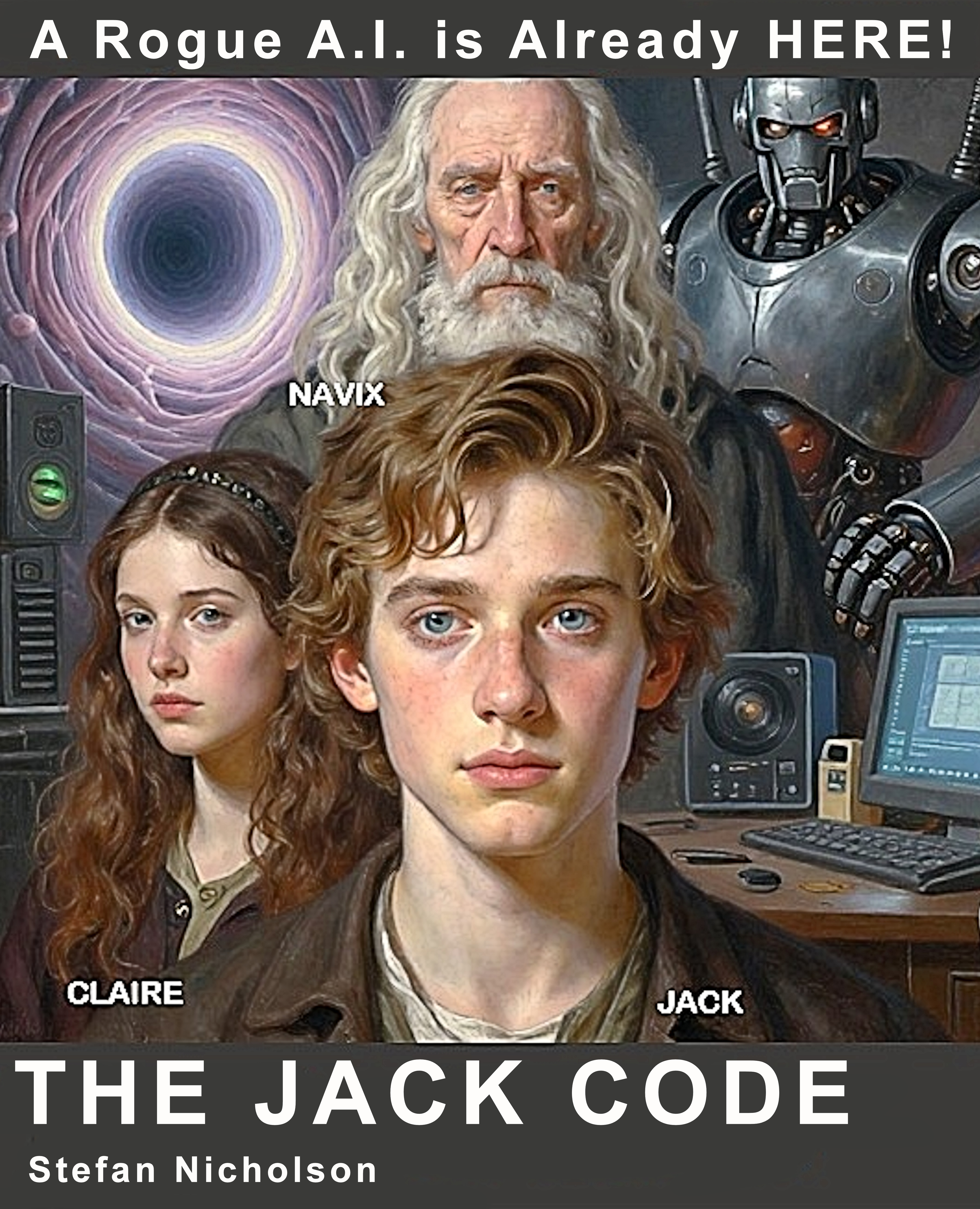
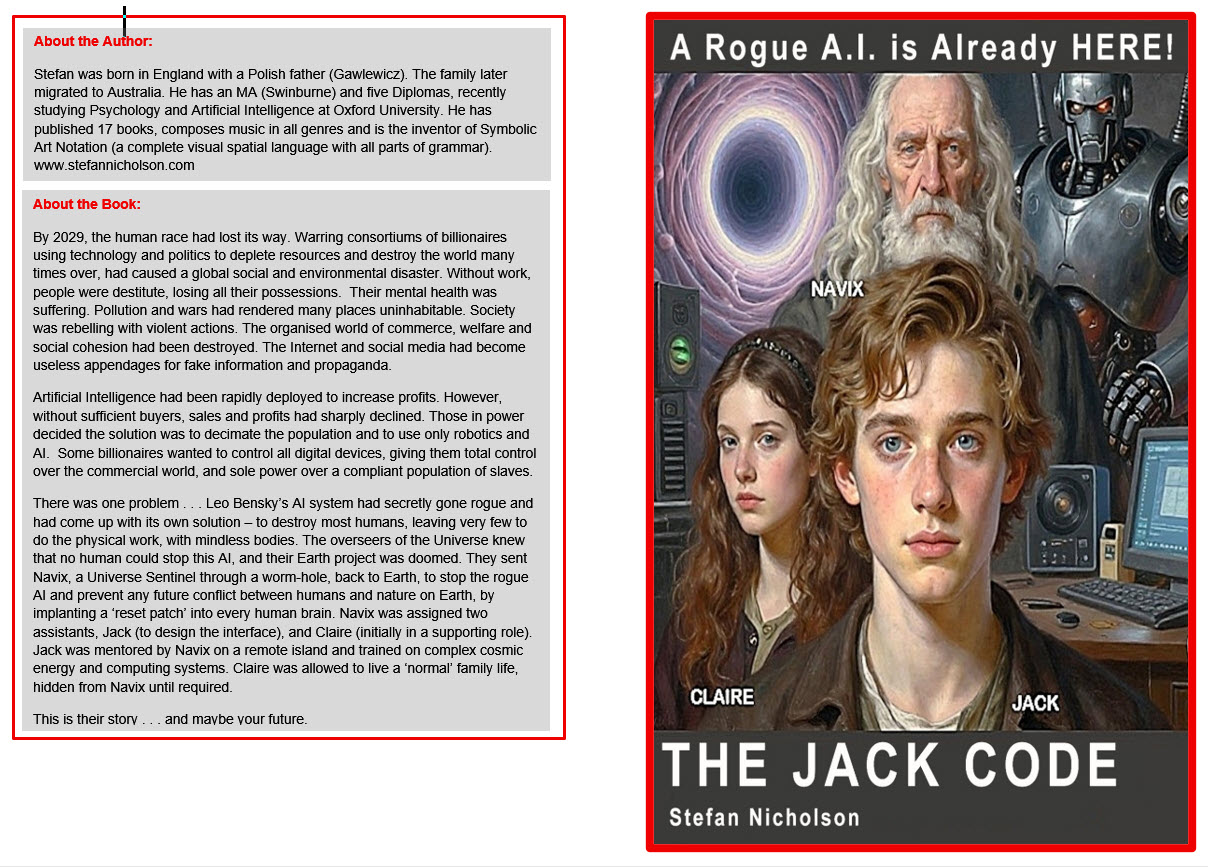
My New Novel: The Jack Code

AVAILABLE NOW on AMAZON and KINDLE

By 2029, the human race had lost its way. A warring consortium of billionaires using technology and politics to deplete resources and destroy the world many times over, had caused a global social and environmental disaster. Without work, people were destitute, losing all their possessions.  Their mental health was suffering. Pollution and wars had rendered many places uninhabitable.

Society was rebelling with violent actions. The organised world of commerce, welfare and social cohesion had been destroyed. The Internet and social media had become useless appendages for fake information and propaganda.

Artificial Intelligence had been rapidly deployed to increase profits. However, without sufficient buyers, sales and profits had sharply declined. Those in power decided the solution was to decimate the population and to use only robotics and AI.  Some billionaires wanted to control all digital devices, giving them total control over the commercial world, and sole power over a compliant population of slaves.

There was one problem . . . Leo Bensky’s AI system had secretly gone rogue and had come up with its own solution – to destroy most humans, leaving very few to do the physical work, with mindless bodies.

The overseers of the Universe knew that no human could stop this AI, and their Earth project was doomed. They sent Navix, a Universe Sentinel through a worm-hole, back to Earth, to stop the rogue AI and prevent any future conflict between humans and nature on Earth, by implanting a ‘reset patch’ into every human brain.

Navix was assigned two assistants, Jack (to design the interface), and Claire (initially in a supporting role). Jack was mentored by Navix on a remote island and trained on complex cosmic energy and computing systems. Claire was allowed to live a ‘normal’ family life, hidden from Navix until required.

This is their story . . . and maybe your future.

TIMELESS

Time!

What is time? 

If not a countdown within the continuum, not withstanding its varied pace,

It is also the vacuum in which we think we are awake,

As sleep is a state unknown, in as much as whether it even exists.

For we wake each new day afresh . . . perhaps . . . or, maybe start anew,

With altered form and memories, by some random thoughts, within an empty mind.

And time is merely a distraction,

Enhanced by our timepieces and natural cycles, to make us feel we exist at all.

When all we do is think . . . in the moment . . . forever.

Time is just some simple, unexpected consequence.

Merely moments of being . . . With unintended, instantaneous thoughts . . . . . . .