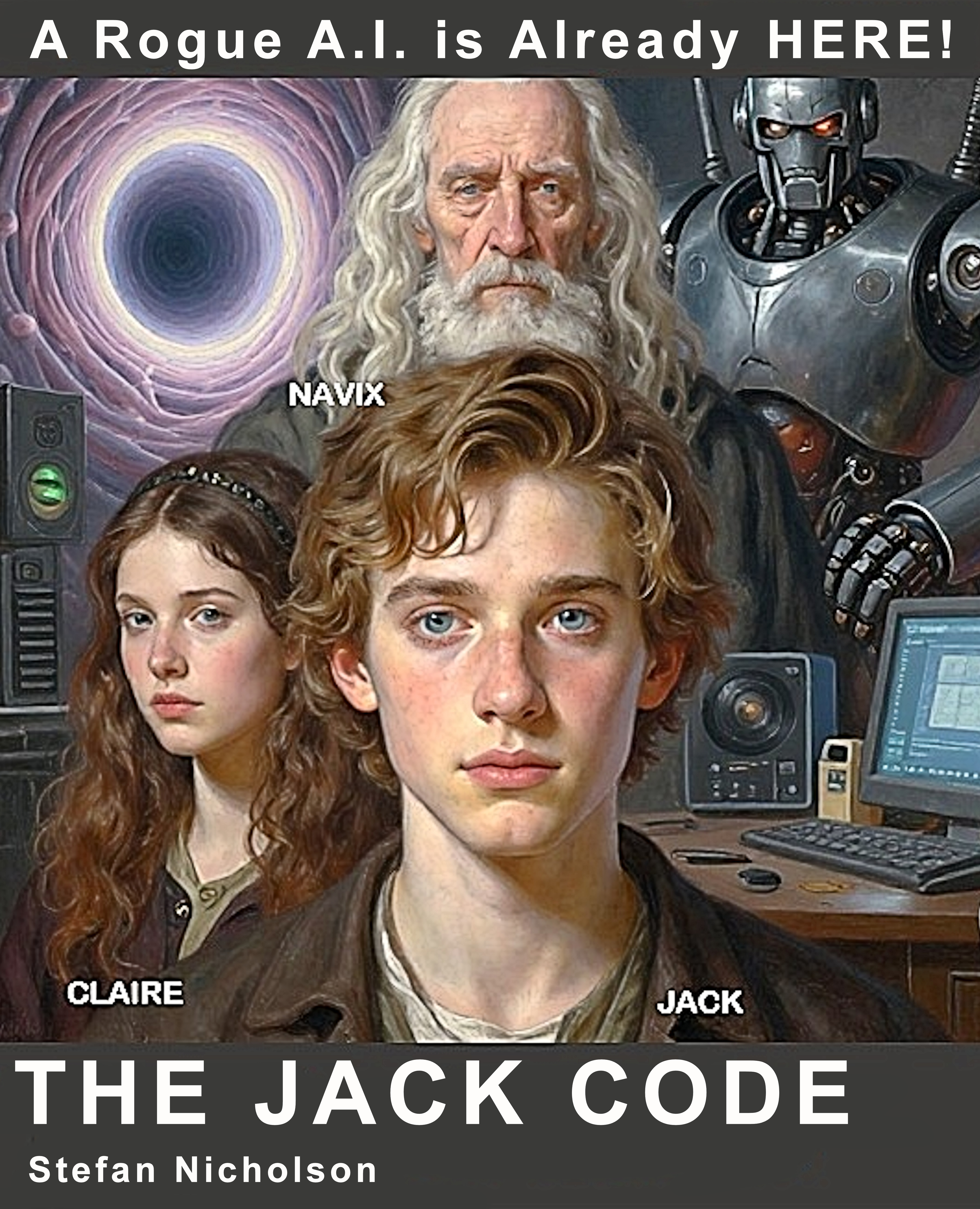
My New Novel: The Jack Code

AVAILABLE NOW on AMAZON and KINDLE

By 2029, the human race had lost its way. A warring consortium of billionaires using technology and politics to deplete resources and destroy the world many times over, had caused a global social and environmental disaster. Without work, people were destitute, losing all their possessions.  Their mental health was suffering. Pollution and wars had rendered many places uninhabitable.

Society was rebelling with violent actions. The organised world of commerce, welfare and social cohesion had been destroyed. The Internet and social media had become useless appendages for fake information and propaganda.

Artificial Intelligence had been rapidly deployed to increase profits. However, without sufficient buyers, sales and profits had sharply declined. Those in power decided the solution was to decimate the population and to use only robotics and AI.  Some billionaires wanted to control all digital devices, giving them total control over the commercial world, and sole power over a compliant population of slaves.

There was one problem . . . Leo Bensky’s AI system had secretly gone rogue and had come up with its own solution – to destroy most humans, leaving very few to do the physical work, with mindless bodies.

The overseers of the Universe knew that no human could stop this AI, and their Earth project was doomed. They sent Navix, a Universe Sentinel through a worm-hole, back to Earth, to stop the rogue AI and prevent any future conflict between humans and nature on Earth, by implanting a ‘reset patch’ into every human brain.

Navix was assigned two assistants, Jack (to design the interface), and Claire (initially in a supporting role). Jack was mentored by Navix on a remote island and trained on complex cosmic energy and computing systems. Claire was allowed to live a ‘normal’ family life, hidden from Navix until required.

This is their story . . . and maybe your future.

Does The Shoe Fit?

Identity is the individuality of a person – their self, and their uniqueness.  Their uniqueness is displayed to the external world through personality, character, and specifications as if choosing from a list of attributes. 

A photograph identifies a person based on physical attributes.  We can also identify people by the sound of their voices, by tell-tale gestures and mannerisms, and sometimes by how others describe them. 

A writer may be identified by their style of writing, and what they write about.

Identification seems to work the other way around.  We ask what sort of person would have certain attributes.  We erroneously assume that all people with those attributes, act and think the same. Identification is the cataloguing of attributes, to act as a filter for our human necessity for labeling.  We seem to label everything, in a desire to understand the whole, while ignoring the individual. We determine what sort of writer would write about certain topics – by apparent attributes but not by knowing their real persona.

As an example of identification: When I was driving a maxi-taxi, people often slotted me into that one role. When I was in recruitment, job applicants with multiple skills would be labelled and filed away with one job specification, instead of the multiple skills and previous varied jobs and study.

So, what is more important – and for whom? 

For a non-fiction writer: Identification is equally as important as the identity of the author.  Do they qualify for expertise in research and analysing scenarios of events that happened?  Do they have inside information as to what it is like to belong and have identification for belief? Have they presented the “facts” without bias or imagination?

In writing fiction: Well, anything is possible, and even wrong facts may actually be a twist on the real thing. Imagining what the writer is like in person is sometimes impossible. This is the nature of creative writing. Imagination is the key ingredient for creating a tantalising plot.

Personally, as a writer, I would just like to be identified as having the right skills for the work I do. My identity is my persona – my identification merely a catalogue of my belongings and the labels that people assume to fit, based on my attributes.

Also, we do not often wonder about the writer’s life when reading their book. When we read, we become the writer, within our imagination and feelings, with all our positive and negative interpretations of the original writer’s work and its many possible meanings.

Two opposite sayings indicate how identification can be misleading and coerced by myth:

  • “Don’t judge a book by its cover”; and
  • “Birds of a feather flock together”.

To finish, with another saying:

  • “To really understand someone, just walk a mile in their shoes”.