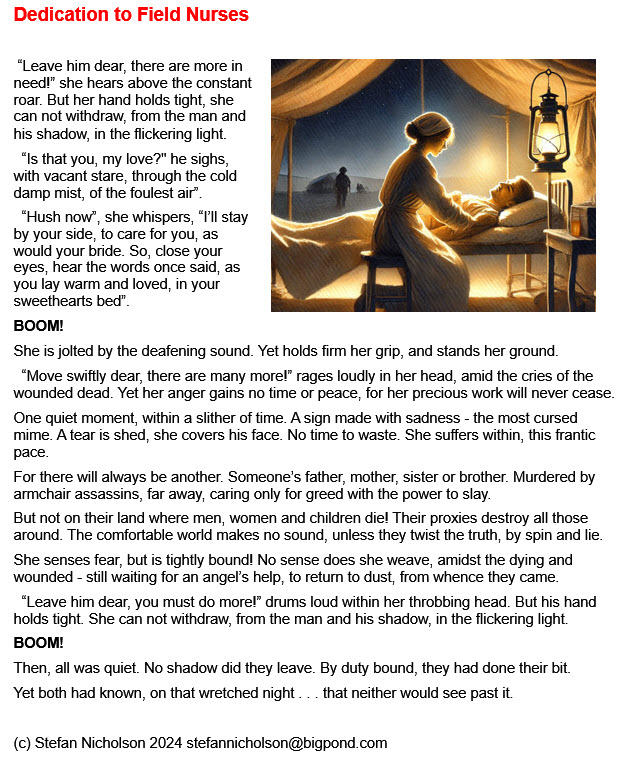
Dedication to Field Nurses
Technical Writing Means Business Continuity and Documenting your Processes via QA and Standards:
It is an important part of documenting your company procedures, work instructions and training manuals.
When senior personnel leave a company, the information that leaves with them is a serious loss to the business. Shift work is often physically differently on each shift (same jobs) due to poor training or instructions passed down from changing staff members – often with errors and dangerous short cuts.
Best Practice work instructions and procedures combined with effective training will ensure that your workforce is following safe work practices and maintaining quality of product and services by doing the job safely and correctly. The standards set by the company and regulatory authorities will be part of that documentation system.
When people go to work each day, they expect to go home without injury. Companies expect their efficient and safe work environments to produce quality outcomes with a documented audit trail for monitoring the process mechanisms.
Technical Writers should be professionally trained and have wide ‘hands-on’ work experience to help management to maintain their client’s QA and EOH&S systems, providing solutions to meet their documentation requirements. Safety qualifications are a bonus.
Technical Writers communicate in a concise and effective manner, using diagrams, photos, spreadsheets, data-bases and illustrations to support the text. Multi-Media can be effective in providing on-line and easily accessible training courses that are available 24/7.
A Technical Writer uses research methods, interview techniques and reference document analyses (PFDs and P&IDs) to support site visits and existing documentation to develop new “best practice” documentation to suit the target audience. In fact, some manuals are developed and finalised only from engineering and design documents – even before the equipment, plant or business system has been physically built.
Technical Writing fees can be casual, part-time, full-time, contract (hourly, daily, weekly) and fixed-fee arrangements to suit your budget and deadlines.
Please let me know if you have any questions about your own documentation projects – no job is too big or too small. Using professional technical writers could even save a life.
email: stefannicholson@bigpond.com phone: 0417181077
Excerpts from my Ruby Spy Novels
It all seems much easier now, to accept that soldiers always have to follow orders, regardless of what they think about them, or who gives them . . . or the consequences of their actions, or the long-term effect on their minds.
Spying is a different ‘game’. It is meant to stop wars and terrorism from happening in the first place . . . especially when diplomacy is in such disarray and lunatics are elected by the naive and apathetic populace. People get who they vote for – but then democracy is only useful for a small population, before imbalance and corruption sets in.
Spies gain information that can be used to counteract and destroy any thoughts of aggression from the perceived enemy, or to eliminate any threat that is likely to prevent a problem from occurring in the first place.
Spying is a game of fake news, propaganda and delusion. No one knows the truth anymore.
There is no “truth”- just the game that a few faceless people play, for their own inadequacies, using gullible and misguided people as their disposable pawns.
The common enemy now hails from those with power and greed, with some people assuming that they have a right to be treated better than others. So, they engage in skimming, side-swapping, terrorism and corruption, media manipulation, destruction . . . and killing.
After note: If we apply Ruby’s thoughts to Ukraine as an example. We know the top players from their latest “game” and what they do. The rest of the world suffers at the hands of just a few people . . . as they always have done.
Ruby Trilogy:
All available on Amazon as a book or as a Kindle e-Book.
Identity is the individuality of a person – their self, and their uniqueness. Their uniqueness is displayed to the external world through personality, character, and specifications as if choosing from a list of attributes.
A photograph identifies a person based on physical attributes. We can also identify people by the sound of their voices, by tell-tale gestures and mannerisms, and sometimes by how others describe them.
A writer may be identified by their style of writing, and what they write about.
Identification seems to work the other way around. We ask what sort of person would have certain attributes. We erroneously assume that all people with those attributes, act and think the same. Identification is the cataloguing of attributes, to act as a filter for our human necessity for labeling. We seem to label everything, in a desire to understand the whole, while ignoring the individual. We determine what sort of writer would write about certain topics – by apparent attributes but not by knowing their real persona.
As an example of identification: When I was driving a maxi-taxi, people often slotted me into that one role. When I was in recruitment, job applicants with multiple skills would be labelled and filed away with one job specification, instead of the multiple skills and previous varied jobs and study.
So, what is more important – and for whom?
For a non-fiction writer: Identification is equally as important as the identity of the author. Do they qualify for expertise in research and analysing scenarios of events that happened? Do they have inside information as to what it is like to belong and have identification for belief? Have they presented the “facts” without bias or imagination?
In writing fiction: Well, anything is possible, and even wrong facts may actually be a twist on the real thing. Imagining what the writer is like in person is sometimes impossible. This is the nature of creative writing. Imagination is the key ingredient for creating a tantalising plot.
Personally, as a writer, I would just like to be identified as having the right skills for the work I do. My identity is my persona – my identification merely a catalogue of my belongings and the labels that people assume to fit, based on my attributes.
Also, we do not often wonder about the writer’s life when reading their book. When we read, we become the writer, within our imagination and feelings, with all our positive and negative interpretations of the original writer’s work and its many possible meanings.
Two opposite sayings indicate how identification can be misleading and coerced by myth:
To finish, with another saying:
 Stefan A Nicholson (Tasmania)