
One of 77 poems in my book: “Frames of Poetry” – available from Amazon
One of 77 poems in my book: “Frames of Poetry” – available from Amazon
OPENING SCENE:
(Squeaky talking and chirping noises in background)
Roger (radio producer) enters into broadcast area and seeks information from Paul (off-air presenter).
ROGER
What’s all that noise in the background?
PAUL
What noise?
ROGER
All that chirping noise . . . listen . . . there it goes again.
PAUL
Oh that’s the News Roger . . . the afternoon news.
ROGER
The News. Good heavens . . . why does it sound like little munchkins having a tea party . . . and . . . it’s not going to air . . . surely not?
PAUL
Oh it’s live alright. I’m not too keen on it myself . . . but you did give it the go ahead.
ROGER
When and why would I agree to have that chirping and whistling going to air instead of the normal News program with Linda and her team?
PAUL
That is Linda. You told her not to read the News on air ever again . . . and fired her!
ROGER
Yes . . . yes I remember now . . . so why is she still here then . . . and reading the News in that peculiar way like that and disturbing my listeners . . . and advertising executives! Stop it immediately!
PAUL
Well she’s not reading the News on air today . . . she went and got some Helium, took a few deep breaths and is now reading the News on Helium instead.
ROGER
You’re ALL fired!
PAUL
Impossible me old gaffer!
ROGER
And why’s that!
PAUL
We all quit this morning to work for another station . . . tarah then! Come on Linda . . . let’s leave old grumpy here and start working for a real radio station.
(Motions to Linda to stop broadcasting and to leave the station)
THE END
(from my book “Short Comedy Routines for Novices” – available Amazon and Kindle)
The language that can be understood by any nationality at the same time.
Can be learnt in only 2 hours with a trained tutor.
(Invented and developed by Stefan Nicholson in Tasmania, Australia)
My aim is to enable young children to learn how to communicate, using language and coding, before they start school—and during their primary years, without the mastery of talking, hearing, alphabets, words, spelling, pronunciation and formalized grammar.
Also, it is my aim to provide an easy communication tool for those people who have difficulty in learning – to develop their language brain pathway to accommodate change and benefit to their well-being.
Early communication can be fun as well as rewarding. It gives people an early start to be able to relate to others and progress onto formalized national and cultural languages.
Early education is a known processor for developing happier, confident and better rewarded adults.
Symbolic Art Notation can be learnt quickly, stimulating the brain, taken seriously and also as a game – for early mastery of our built-in language processor in the brain. The attached PDF book can be controlled by the embedded hyperlinks for ease of use.
Time!
What is time?
If not a countdown within the continuum, not withstanding its varied pace,
It is also the vacuum in which we think we are awake,
As sleep is a state unknown, in as much as whether it even exists.
For we wake each new day afresh . . . perhaps . . . or, maybe start anew,
With altered form and memories, by some random thoughts, within an empty mind.
And time is merely a distraction,
Enhanced by our timepieces and natural cycles, to make us feel we exist at all.
When all we do is think . . . in the moment . . . forever.
Time is just some simple, unexpected consequence.
Merely moments of being . . . With unintended, instantaneous thoughts . . . . . . .
(from my book: “Introverted Moments” – available on Amazon)
The Writing of History and Biographies
I am a great fan of Lewis Carroll – the mathematician who became a writer of children’s books and nonsense poetry. He observed the world around him, and applied logic to show that what we see, and our understanding of it, depends on your perspective. So too, with the writing of history: people, places and times.
Wearing his hat for a few minutes, I would have to conclude, that everything that is not most useful, is necessarily less useful) – an interesting question for this week. And yet, if anything is useful, it is just that – otherwise it would be useless. Say that fast, three times.
From historical evidence and sequence of events, a biographer presents the logic of the true event, and the story teller within, moulds this into the storyline – or it can work the other way around. Biography is the true story – as can be reasonably told based on fact and reasoning, notwithstanding that some biographers lie through their teeth.
So, how do you write about history?
Where to go from here with the writing of your next book?
“That depends a good deal on where you want to get to,” said the Cat
“I don’t much care where ——“, said Alice.
“Then it doesn’t matter which way you go,” said the Cat
“—- so long as I get somewhere,” Alice added as an explanation.
“Oh, you’re sure to do that,” said the Cat, “if you only walk long enough”
(excerpt from Lewis Carroll’s “Alice in Wonderland”)
I am going to have a long thoughtful walk, and plan out another interesting historical work. I lived the life of Adam Lindsay Gordon for long enough to share his experiences, when I wrote a poem for the Adam Lindsay Gordon Association – and came out of it a wiser man – and second prize winner.
Best regards to everyone. I hope to be reading your published works in the near future.
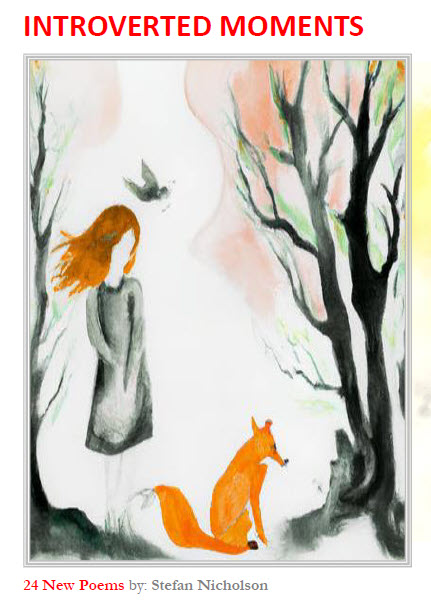
Another poem from my “Introverted Moments” book, available on Amazon.
Herein is a clue to the answer.
Onward and upward to reach the summit of possibilities.
Perhaps a peek into the future?
Everyone must think they can solve the riddle.
The answer is HOPE
With the Aurora appearing in many parts of the world due to massive solar ejections from coronal holes (sun spots), I thought I would post a personified poem about it.
I kissed this girl.
She turned to dust!
The wind blew her far away.
Then I wondered why the dust did swirl,
Thinking, she maybe was about to stay.
She is my cosmic girl and I love her so.
Aurora shines when she comes and goes.
With electric eyes and magnetic lips,
Fluorescent hair and those fusion hips.
She is a girl on fire
Charged like an electric wire,
She’s my Supergirl from Skog.
My astral flame, my heart’s desire.
She is a solar star . . . my mystagogue.
This poem is from my 2024 poetry book, titled “Introverted Moments” – available from Amazon Books – read below by “Digital Ami”.
Technical Writing Means Business Continuity and Documenting your Processes via QA and Standards:
It is an important part of documenting your company procedures, work instructions and training manuals.
When senior personnel leave a company, the information that leaves with them is a serious loss to the business. Shift work is often physically differently on each shift (same jobs) due to poor training or instructions passed down from changing staff members – often with errors and dangerous short cuts.
Best Practice work instructions and procedures combined with effective training will ensure that your workforce is following safe work practices and maintaining quality of product and services by doing the job safely and correctly. The standards set by the company and regulatory authorities will be part of that documentation system.
When people go to work each day, they expect to go home without injury. Companies expect their efficient and safe work environments to produce quality outcomes with a documented audit trail for monitoring the process mechanisms.
Technical Writers should be professionally trained and have wide ‘hands-on’ work experience to help management to maintain their client’s QA and EOH&S systems, providing solutions to meet their documentation requirements. Safety qualifications are a bonus.
Technical Writers communicate in a concise and effective manner, using diagrams, photos, spreadsheets, data-bases and illustrations to support the text. Multi-Media can be effective in providing on-line and easily accessible training courses that are available 24/7.
A Technical Writer uses research methods, interview techniques and reference document analyses (PFDs and P&IDs) to support site visits and existing documentation to develop new “best practice” documentation to suit the target audience. In fact, some manuals are developed and finalised only from engineering and design documents – even before the equipment, plant or business system has been physically built.
Technical Writing fees can be casual, part-time, full-time, contract (hourly, daily, weekly) and fixed-fee arrangements to suit your budget and deadlines.
Please let me know if you have any questions about your own documentation projects – no job is too big or too small. Using professional technical writers could even save a life.
email: stefannicholson@bigpond.com phone: 0417181077
Excerpts from my Ruby Spy Novels
It all seems much easier now, to accept that soldiers always have to follow orders, regardless of what they think about them, or who gives them . . . or the consequences of their actions, or the long-term effect on their minds.
Spying is a different ‘game’. It is meant to stop wars and terrorism from happening in the first place . . . especially when diplomacy is in such disarray and lunatics are elected by the naive and apathetic populace. People get who they vote for – but then democracy is only useful for a small population, before imbalance and corruption sets in.
Spies gain information that can be used to counteract and destroy any thoughts of aggression from the perceived enemy, or to eliminate any threat that is likely to prevent a problem from occurring in the first place.
Spying is a game of fake news, propaganda and delusion. No one knows the truth anymore.
There is no “truth”- just the game that a few faceless people play, for their own inadequacies, using gullible and misguided people as their disposable pawns.
The common enemy now hails from those with power and greed, with some people assuming that they have a right to be treated better than others. So, they engage in skimming, side-swapping, terrorism and corruption, media manipulation, destruction . . . and killing.
After note: If we apply Ruby’s thoughts to Ukraine as an example. We know the top players from their latest “game” and what they do. The rest of the world suffers at the hands of just a few people . . . as they always have done.
Ruby Trilogy:
All available on Amazon as a book or as a Kindle e-Book.
Identity is the individuality of a person – their self, and their uniqueness. Their uniqueness is displayed to the external world through personality, character, and specifications as if choosing from a list of attributes.
A photograph identifies a person based on physical attributes. We can also identify people by the sound of their voices, by tell-tale gestures and mannerisms, and sometimes by how others describe them.
A writer may be identified by their style of writing, and what they write about.
Identification seems to work the other way around. We ask what sort of person would have certain attributes. We erroneously assume that all people with those attributes, act and think the same. Identification is the cataloguing of attributes, to act as a filter for our human necessity for labeling. We seem to label everything, in a desire to understand the whole, while ignoring the individual. We determine what sort of writer would write about certain topics – by apparent attributes but not by knowing their real persona.
As an example of identification: When I was driving a maxi-taxi, people often slotted me into that one role. When I was in recruitment, job applicants with multiple skills would be labelled and filed away with one job specification, instead of the multiple skills and previous varied jobs and study.
So, what is more important – and for whom?
For a non-fiction writer: Identification is equally as important as the identity of the author. Do they qualify for expertise in research and analysing scenarios of events that happened? Do they have inside information as to what it is like to belong and have identification for belief? Have they presented the “facts” without bias or imagination?
In writing fiction: Well, anything is possible, and even wrong facts may actually be a twist on the real thing. Imagining what the writer is like in person is sometimes impossible. This is the nature of creative writing. Imagination is the key ingredient for creating a tantalising plot.
Personally, as a writer, I would just like to be identified as having the right skills for the work I do. My identity is my persona – my identification merely a catalogue of my belongings and the labels that people assume to fit, based on my attributes.
Also, we do not often wonder about the writer’s life when reading their book. When we read, we become the writer, within our imagination and feelings, with all our positive and negative interpretations of the original writer’s work and its many possible meanings.
Two opposite sayings indicate how identification can be misleading and coerced by myth:
To finish, with another saying:
“Cool Cat” – (c) Stefan Nicholson 2015 Tasmania
OPENING SCENE:
(James is playing “Clair de Lune” on piano which has a bust of Debussy on top – His cat is sitting next to the bust)
Eric who is not very sharp, enters the room and looks unaware of his environment and has a blank look.
Eric
Wow man . . . who wrote that cool music? . . . It’s all floaty and surreal man.
James
(Points to the composer’s bust on piano, next to the cat)
Debussy. Yeah it sounds like some random falling of leaves on a winter’s night.
Eric
(looking at the cat which stretches out its paws)
Are you messing with me man. Is that the dude?
James
No kidding man . . . Claude Debussy. A French composer, who wrote it one night while looking at the moon.
Eric
(looking at the cat and talking slowly)
Well done Claude, that is a very nice piece of music . . . if you understand English man.
James
Good grief Eric . . . I was pointing at the composer’s bust.
Eric
Wow, sorry man for missing the clue. So sorry Claudette, for making a huge mistake with the boobs and all.
(James crashes his head into the keyboard and bangs his hands up and down on the keys)
Eric
Wow man . . . is that another one of the pussy’s compositions?
James
Are you planning to have children in the future Eric . . . because they would probably smother you while you were sleeping, around the age of three when they would surely realise that cats DO NOT compose music!
Eric
But what about . . . ?
James
Don’t you ever mention “Cats” the musical in front of my cat . . . you may give it grandiose ideas.
THE END
Hayley was a wild child – bright, yet inwardly dark,
Smiling, kind and thoughtful – honesty was her mark.
Much older beyond her years she seemed
While others chose greed she observed and dreamed
About what folks wished they were, not are,
No time to cast their thoughts afar.
She saw folks willing to share all and give.
Others poor, sick and troubled – just dying to live.
Some giving in too easily with a careless wistful sigh,
Yet soldiers fight for them to live –we honour where they die.
So young Hayley tried with all her might,
To protect our world from lack of foresight.
For they lay where they fell on foreign ground in Fromelles,
“And none shall forget this,” so this Australian would tell
As she forged her ground from those who fought there,
Feeling through her compassion as their souls were laid bare.
Changed her name to sound patriotically strong and proud,
To Strayley-Anne. Reborn to rise up above the crowd.
“Lest we forget,” she would sigh for those she had never met,
As if listening to their orders to stand fast and to protect.
Then wondered if they would smile or frown from the darkness where they lay,
Or cry out loudly with angry words, to make us “Go away!”.
Twisted stories
About past glories
Armies ever younger.
Those in power
Fear and cower
Not for them
The scourge of hunger.
Days go past, they go so fast
They do not last as much, as they once used to.
Fake news and propaganda, economies that wander
Away from young and poor folk, to feed the idle rich.
And when it comes the time to vote,
When politics resembles a leaky boat.
There’s no difference when the parties switch,
Subdued by their promised, short-term, lying pitch.
If you’re heading back to Hobart on an autumn day,
You will see the mountain rising over Sandy Bay.
When you feel that light wind blowing up from old Iron Pot,
Then, you know you’re surely blessed with what you’ve got.
Come and roam our island home
You will always have a place to call your own.
Hear the wind call you home
It’s time. Return with sails aloft, full blown.
Have you heard the cat play fiddle in the city mall
Or have you shopped in Salamanca at a market stall
Or explored the Channel sailing out from Oyster Cove?
Oh, there is always somewhere close to rest or rove.
Come and roam, fresh air and crashing foam,
See the rolling hills and rivers flow.
Hear the wind call you home.
It is time. Return with sails aloft, full blown.
Note: Song lyrics and music by Stefan Nicholson
Father Christmas stops to pray
Wise men gather ‘round the hay.
All is calm as star shines bright.
Jesus Christ is born tonight.
Christmas always is a time of joy
Children wishing for some special toy
Carols sung by candle-light
All about this special night.
Reindeer prancing on the roof top
Dancer’s dancing . . . clip, clop, clop
Father Christmas . . . hear him singing
Down the chimney, on this night.
Yet, joy and happiness are all we seek
Peace for all . . . strong and weak.
No more sadness, nor to weep.
Now sleep my darling, sleep, sleep sleep.
The typical structure for summarising a screenplay in three acts, would be:
ACT ONE:
ACT TWO:
ACT THREE:
(c) Stefan Nicholson 2009
Well . . . here is a story line that has me thinking . . . but obviously not too deeply.
Hmmmmm, Canterbury Tales meets 60 Minutes.
What if people cared enough about fixing things?
What if we could actually get along with each other and just trade our goods for mutual benefit?
How would I start? How would it end – before the over-prescribed medications kick in?
Why am I asking you?
It was a dark and stormy night alright – the power grid was down again and the writer’s tummy was rumbling for lack of food. Woolies and Coles had sold out, to Amazon.
“The Economy doesn’t bloody work!!” shouted the inebriated economist who could not pay for the next round of drinks, or get up from the floor.
“Sit ordinary people down with a beer and a few slices of pizza and they will tell you how to fix the economy, the health system and the education system, where kids can’t read and write after 10 years in ‘school’. Academics, politicians and business executives who are in economics should be exported as burly for fishing,” replied the once-rich cray fisherman, now selling seagull poo to the social elite as ‘White Gold’.
“Many of our problems can be fixed quickly, efficiently and without bias. We need to stimulate the economy by getting manufacturing going locally, instead of importing goods. A business that buys goods, orders them on demand from overseas, and sells them at a higher price as sole agent is a sham, if those goods can be made here,” added the tradie, wearing his hi-vis shirt, to prove he has a job.
“We give away our land, water, minerals and profitable businesses for a song and then work for foreign companies. Those in the know sell their assets and shares, just before they drop in value, readying themselves to buy again, at the bottom of the abyss. Insider trading is rife,” screamed the passing ten year-old girl in tears, making her way to the scrolling, red-lined computer display.
Dan, the independent member for Stupor was becoming fidgety, and started to rave on as usual about all the things that he could change, if only someone would let him into a major political party.
“The multinationals take our natural resources and pay little or no tax. The media giants try to dumb us down, uninformed with biased news, and bombard us with their advertising and fake business articles. The inequity between government and private schools is another rort. Health, education and policing, should be uniform across all of Australia. We are over-governed by states and councils, overwhelmed by their administrative avalanche of paperwork and red-tape. Make television programs for normal, sane people (not cheap rubbish to meet the 10% local content rule). Stop splintering up major mental and social problems into narrow help-groups, creating more administration and less ‘clout’ for lobbying our politicians to act. With mental problems on the rise, it seems incredibly uncaring to keep closing down formal government assisted services.”
All the people at the bar looked around at once. Dan’s trousers had fallen down as a metaphor for the economy. It was deathly silent (trousers can’t talk without A.I.). There was no one left to say anything . . . . .
The observing writer took his cue to end the rambling story. It had run its course and had died.
“And so, we all lived happily ever after . . . abandoning all hope for the future. We then decided to seek out a meeting place where we could think quietly,” he raced off confidently.
Thank God there were churches for sale, and the flock had gone to greener pastures. Dan now wants to be an angel. I bet there’s money in that caper. Bloody economy!
After-thought . . .
If even one political party had policies for addressing all the problems of today, we may have a chance to get people interested in helping to solve them. But we don’t. They are only self-serving to their own interests . . . and to ensure they get re-elected every 3 years. We don’t have a 5 year plan, never mind a 10 year plan. Your children will grow up with today’s values. They can’t survive with that!!


I’m not even going to mention COVID (Blast!!!)
Anyway, let’s get on with what this post is all about. It is about getting the RIGHT Job.
You may be lucky (or unlucky) to be:
Then do I have the information that may help you?
YES (How obvious was that little dangler)
And here it is:
I wrote most of this when I was working in a boutique Recruitment Agency in Perth (Premium Personnel with Mary McArdle). I regard working with Mary and her company one of life’s highlights, for their caring and nurturing approach to Personnel Management and people.
People need work to acquire some purpose in life. For some people, work that they enjoy is no longer just work. That is why it is important to try and find work that is enjoyable and stimulating.
Once your mind is set on what you want to do in life:
Best wishes that you find your perfect job.

